

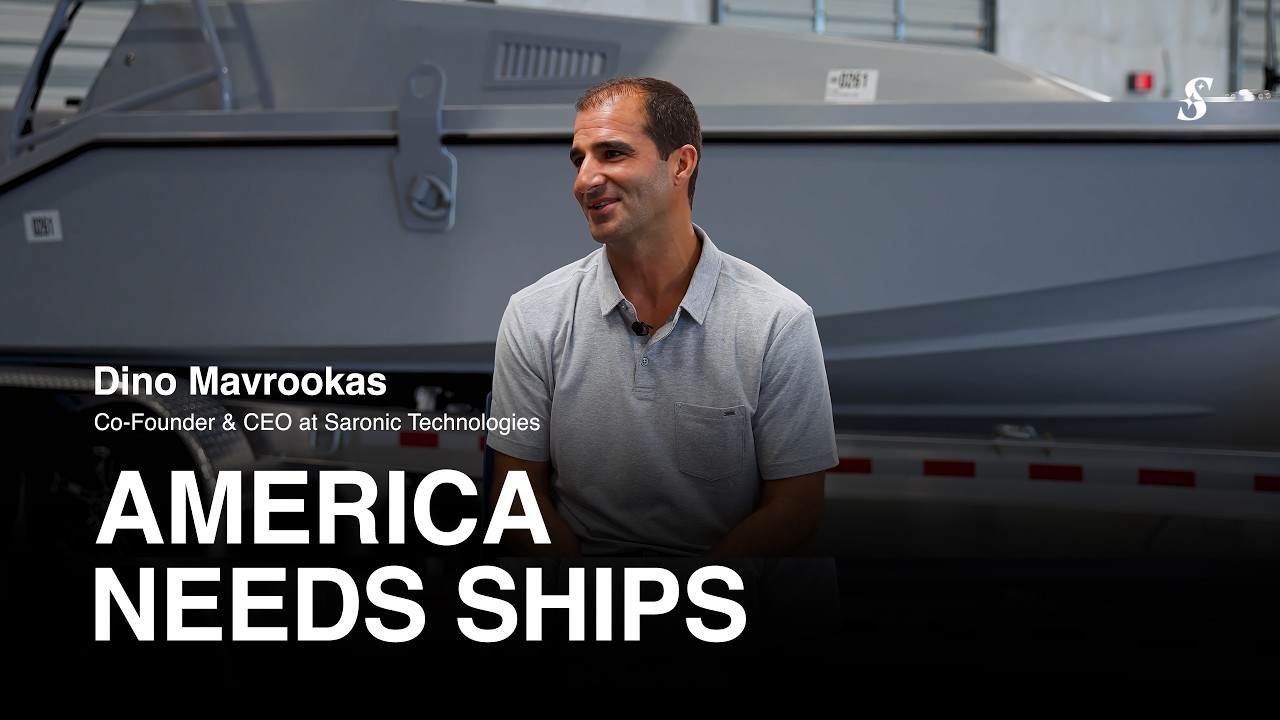

Shipbuilding gap0:00
Being successful in real space, doing hard tech, building real things, and manufacturing with real tangible items is going to be the moat of the future.
I think a lot of commercial boats, you kind of target the human beings to take like 0.4 to 0.6 Gs maybe. Our boats, we've seen accelerations north of 20 Gs before. A human would not take that. It'd be very dangerous for a human to be on that if it's going that fast.
The technology that we're creating is having an impact on real people, real operations. I'm looking forward to shaking the hands of those two Apache pilots.
What we're building at Saronic will not only provide more capabilities faster, but it'll save the taxpayer hundreds of billions of dollars by driving down costs as well.
To set the table, we talked a bit about your stats when we started the last walking tour, and if you haven't watched it, you should watch it. But so you're now at over a $9 billion valuation, you raised $2.6 billion, you've just announced—this was a little debate—is this still going to be fresh in a month?
I think so. But Port Alpha, $3 billion, Port Alpha. So I guess to bring all that to focus against the backdrop of what's going on in America, I'd love for you to lay out kind of the stats that we're working with.
Palantir CTO, Sean, just talked about this, but we're ratioed by China in shipbuilding.
It's actually pretty crazy. So China outbuilds the U.S. 230 to 1. The naval fleet that we have today is actually shrinking. So there'sright around 290 ships in our naval fleet. In 2018, Congress actually set a statutory minimum of 355 ships.
That was eight years ago. And we're going in the wrong direction. In 2024, the Navy actually looked at it and said, "Oh, we don't actually need 355, we need 381." And these are just manned ships, let alone all the unmanned ships that we're going to need in our fleet.
You see the President's budget request for $1.5 trillion. They put out a maritime executive order and the maritime action plan specifically around shipbuilding. You have the Ships Act, which is in Congress, which is focused on obviously the shipbuilding industry.
So there's a lot of focus on defense, defense technology, the industrial base, and shipbuilding, and things are changing. But when you look at the budget today, just look at the Department of War's budget, we talked about the request for $1.5 trillion and where the budget is today,right around a trillion dollars for '26.
1%. 1% went towards autonomy. So that just gives you a sense of how far we actually have to go. And in terms of the bureaucracy and what needs to change, you're getting a lot of push from the top down, from leadership, from the administration, which I just highlighted, from Capitol Hill to invest in things that are not only much more economical but also scalable.
And when you talk about ships, one of the biggest examples is aircraft carriers,right? They take over 10 years to make one. And that number increases by the day, actually, because the program is just later and later and later.
And the cost keeps going up and up and up. I was actually quoting $13 billion for an aircraft carrier, and I was at an event where the President spoke just last week, and he quoted $19 billion. And I was like, "What is happening to the budget here?"
So you have a lot of focus from Congress because, look, there's a 30-year shipbuilding plan in the Navyright now. We talked about going from 290 to 381 over 30 years. That'll cost $1.2 trillion if we can even execute as a country in the first place on that plan.
What we're building at Saronic will not only provide more capabilities faster, but it'll save the taxpayer hundreds of billions of dollars by driving down costs as well. I'll give you a fun sad. I'll laugh at myself a little bit.
I don't actually know this. The Army actually has more boats than the Navy does. But we're focused on all the services: Navy, Army, Marine Corps, Coast Guard, how can we support the Air Force in combat search and rescue and other things.
So we're focused on the military at large. The Navy was our initial and still is our largest customer. And as we're building autonomous surface vessels, that makes a ton of sense. How do we redefine what that naval fleet of the future can look like and should look like?
And we're figuring that out together in partnership with the Navy, but very focused on all the services, very focused on commercial. And also internationally,right? Our allies are just as important in this effort,right? How do we make sure that our allies have the best technology out there?
Because it's not just the U.S. that's struggling in shipbuilding. China has 57% of total global shipbuilding capacity. A lot of our allies are struggling with the same things that the United States is in the lack of ability to just build ships.
And if you go back in history and you look at even just back to World War II, what has typically just determined naval power is who can build the most ships. It's not who can build the most exquisite, the most expensive, whose ships have the most on them in terms of payloads and weapons and all the other things.
It's like who can just build the most? Who has the industrial base to just build the most? And that kind of determines naval power. And that's the whole genesis behind Saronic.
Isn't there a certain, like, in China, don't you have to build every boat to military grade?
I don't know. It's a very opaque market, by the way.
I would imagine.
It's very hard to get information out of there. But they're building, I'll tell you, they're building all types of ships. And the biggest discrepancy really is in the commercial market. And what that commercial market, again, lets them do is take the industrial capacity really from the world,right?
And they're doing that by undercutting on price. Their entire shipbuilding industry is completely subsidized. Not only direct construction subsidies, but they subsidize the raw materials, they subsidize the labor, and they basically give them free financing for these shipyards.
So I'll give you a commercial stat. So we're talking about 230 to 1. It's actually not as egregious when you look at just military ships. We being the U.S. launch about 5 to 10 military ships, meaning destroyer, cruiser, aircraft carrier, like straight naval vessel, warship.
China's probably doing about 30. So 6 to 1, 7 to 1, somewhere in there. They built over 1,000 commercial ships last year. The United States built 5. I think this was 2024. Five. Like 1, 2, 3, 4, 5.
Large ocean-going commercial vessels. So what China's doing is they're taking the capacity from the rest of the world. Our allies, South Korea and Japan, the next two largest shipbuilders in the world, they're actually on the commercial side, they're actually getting a lot of their modules from China.
They're getting a lot of their labor from China. So as that capacity diminishes, if we ever actually do get into a, God forbid, a conflict in the Taiwan Strait that leads to World War III or anything dramatic like that, I mean, China can outproduce the rest of the world in terms of ships.
And they just keep taking that capacity by undercutting the world on price in the commercial market.
Doug, welcome to Sourcery.
Meet Doug8:05
Thank you. I'm excited to be here.
I mean, we're on this big Saronic tour today. You're the COO. How did you get here? How did you get involved?
Yeah, yeah. So I connected with Dino in 2022. At the time, it was actually just the two of us. Dino was here in the Founder in Residence program at APC. I've bounced around maritime tech for, gosh, I'm getting old, so the better part of two decades at this point.
And actually just came off an opportunity working on submarines. Happened to connect with Dino. Turns out it really only takes a good breakfast to get me to throw in my lot with Saronic. But from there, it was really, that was history.
We started the company, started hiring, started building, and started developing. Early Saronic was super fun. I don't think I appreciated how fun it was until I looked back at it. It was scrappy. It was kind of very stereotypical.
We were quite literally in a garage here in South Austin. Everything wasurgent, everything was new, everything was impactful. It was a special time.
And now you've scaled up, $9.25 billion valuation. You've raised $2.6 billion in total. And you have some pretty amazing partnerships. So walk me through some of your recent partnerships. You have one with Palantir. You have one with Path.
How did those come together?
Yeah. So I guess some broader contacts. I think out of the working population here at Saronic, roughly 1,600 folks roll up through my org. So a lot of the executional arm of the business tends to be in operations here at Saronic, and we think about that very critically.
Partnerships9:25
Palantir's pretty straightforward. So we're on their foundry program. We use them for a lot of our built-in tooling, our internal manufacturing execution systems, some of our MRP, material resource planning tools. Think of it like kind of the backbone software that plans out the logistics of the business.
A lot of that runs on foundry. And it's actually been a surprisingly easy adoption curve. Everyone from the supply chain analyst to maybe somebody in GR and PR, they're all in those tool sets. They're all developing, making their own dashboards, kind of pushing that needle forward.
Path is interesting. So you're probably aware that we both have this facility here in Austin. We think about the local Texas footprint as building boats, whereas ships carry boats. Boats are significantly smaller. Franklin is obviously our first foray into ships.
That's where we've been exploring with Path. The real hard problem to solve there, and it's something that I think we've been collaborating on with them aggressively, is how do you do aluminum welding? And it's making progress. And it's not just, can you tack a piece of aluminum together?
It's, can you actually do it in such a way that it goes and passes all of the ABS, IMO, Coast Guard certifications associated with that work?
What has that process, I mean, that one is particularly interesting because it's very tangible too,right? So what have the processes of scaling this out so massively in such a short period of time been like?
Little things that seem trivial matter a lot. So I have the hardware engineering organization as well as the supply chain organization. Silly things like part numbers,right? How you think about part numbers, how they flow through the system, how they result in CAS accounting and being able to invoice, all those things are actually really important to get forward.
In context of like how we think about robotics, that's an interesting kind of question. Here in the boats world, we're still what I would consider high mix, low volume in context of the broader world. We're not building 100,000 or a million like you might see in consumer electronics.
So while it's present, it's a little bit of a lighter touch. The shipyard is interesting because a lot of our focus, and we can talk about this in context of Port Alpha later, is how do you move a lot of the final outfitting and the on-unit, so like on the ship, traditional work upfront to being done in subassemblies?
And that's where we lean into solutions like Path, bringing those piece parts out, doing them somewhere else, and then assembling modules into larger modules, into super modules.
If you think about, in that period of time, you built Corsair, you built Marauder, you're in production working on Port Alpha. What do the next 10 years look like?
What's probably not widely known is that we're actually two products prior to Corsair. And the reason why I bring that up is because it's important in context of Marauder. So we built a product called Spyglass. We had a really lesser-known product called Cutlass, and then obviously we landed on Corsair.
But this kind of captures how we think about problems. We start small, we build up from there, we build momentum, we build understanding, and then we go and apply it to larger, more complicated systems. So just like Spyglass was to Corsair, you can think of Marauder as being the analogous opportunity to maybe a 400-foot ship or an 800-foot ship or maybe even something larger in the Panama size of 1,200 feet.
How do all the operations work together? How are you managing that?
My beard wasn't always this gray, Molly.
It's a good question. So the way Saronic does business, I don't think is typically, it's not different than other defense contractors. We have a platforms art that does a lot of the R&D, a lot of the development work.
In parallel with that, we have what we call mission operations and services. That's the team that deals with the test cadence, runs the ranges, deploys vehicles all across the world. There also are like first-line customer service arms. So if you think about if there's an issue with Marauder in the field or Corsair or some U.S.
government customers having a challenge with something, they're the team on the ground that brings that information back in and closes the design loop with the engineering team. So in general, I think it's working well. As it expands into Port Alpha in particular, we're starting to brush up on some of these problems here in Franklin.
But things like global supply chain become much more pressing issues. For example, we wound up buying out a vast majority of the aluminum in the Louisiana area, but we went and built Marauder. I've been thinking about that critically, taking that lesson learned.
I've reached out to critical suppliers for Port Alpha, make sure that the steel pipeline is in place, how we're thinking about scaling, kind of moving those rocks ahead of the avalanche that is about to come.
Re-industrializing14:43
I mean, that's a really good point. We're in the precipice of another re-industrial, or I guess not another, but we're directly in the eye of re-industrialization. And so where do you see the biggest stress points on that, whether it's supply chains, talent, finding Port Alphas around the country?
There's a couple, I think, key Lego blocks that need to fall into place here to make this successful. Dino has obviously probably gone on about capital. That's important,right? Part of this is a bit of a chicken and egg problem where you're not going to see movement in the market until you invest in the market and show those demand signals.
So we're fortunate enough that we can do that. We can do that a little bit ahead of need. On the contracting side of house, that's something that I think we're looking for support and love and guidance from the U.S.
gov. The more that the government is willing to lean in, the more that the commercial industry is going to follow suit. And then on the executional side, I think it's interesting. We have a philosophy in our production system that if you think about the last 20 years in defense tech manufacturing, I won't go as far as calling it gatekeeping, but there's been a lot of a focus around
certifications and qualifications. And what that has done is, candidly, it's made a quality system, and that's important, and that's something that we want to retain. But it has kind of precluded a large portion of the labor force of re-entering into that market.
And that's a problem that should be solved systematically, whether it's in how you deal with automated inspection or how you deal with work instructions or how you deal with generally naturalizing somebody to a manufacturing environment. There's no reason somebody who can't change a tire shouldn't be able to go and build a Corsair or work on a Marauder or work on a larger ship.
Break, break. Labor and workforce is certainly a challenge. I think there's a path there. There's plenty of Americans who want to work, who want those kind of jobs. The thing that's going to be a little bit challenging is there's a couple of key industries that I think have generally migrated outside of the United States.
Casting and forging is a big one. I see that being a challenge here in the next three to five years. Same thing, a lot of, actually, we saw recently, a lot of harnessing was previously done in Ukraine or Mexico.
We're starting to see that come to that back in. All of these are things that need a good central gravity in the United States to come back into domestic production for this to be successful.
That's a really good point. So we were just at Sunrise Systems with Jordan Black, the CEO there, and he was talking about how they're bringing wire harnessing and they're bringing it to America to automate it. They saw this problem at SpaceX.
It's crazy and it's very complex. It barely works. It's always a problem. It's a huge headache for everyone. But his point being was more on the talent side of things. So what they did is they created a certified training program there where you usually, it would take you like two years or so to actually learn how to make complex wire harnesses.
And they brought that training program to about four weeks. So how are you, as you continue to scale out, you're going to be hiring tons of people. I mean, I don't know, you guys can't see it, but we're in this very large warehouse that is also dual use as your lunch spot.
Like you're full of people and it's men, it's women, it's like young people, it's older people, it's all this mix. So how are you bringing them in and like giving them the skills and the confidence to build?
It's interesting. I think if you had an opportunity to tour four, there's actually an enormous wire harnessing shop in the background. I know Jordan, I know Sentra, I wish them the best of luck. I think they'll help solve that problem.
But it is a problem set that's larger than just one organization. Similar approach, learning development is important. The barrier to quality, I think, is the challenge that we all want to go and tackle, which is how do you lower the bar of excellence such that somebody with less experience or less talent or less niche can actually go and meet and exceed it?
You can do that through better design and engineering. Candidly, I think that's a place that everybody should be focusing on. Less parts are good parts. It's certainly our mantra here at Saronic. The other one is basics,right? You can do less upfront if your quality and inspection and your pass-through rate is much better on the back end.
So you can focus on automated inspection, digital odometry, all those different things to make sure that the end process is good. And then the last part of this is like you actually do just have to teach people. And the way we think about it is a combination of traditional learning.
So we don't necessarily do classroom learning. Adults candidly learn very differently than going to school as a school-age child. It's more about risk and reward and teaching skills and outcomes. So doing that in partnership with like the traditional apprenticeship kind of model actually works really well as long as you can go and scale that up and make those connections quickly.
So if we look to the future, what are you most looking forward to in the next 12 months? I know that I don't know if that's going to be a long amount of time or a short amount of time for you, but you guys are growing really fast.
Saronic operates in dog years. So that is the mental equivalent of seven years in my mind. Gosh, what does the next year look like for us? That looks us through construction in Port Alpha, which I'm very excited for.
It looks like us standing up auxiliary facilities out in Brownsville. So I think of more testing locations, more inventory, all that jazz. Between you and I, I think we have a couple of products slipped up our sleeve that we'll be introducing in that timeframe as well.
So always excited for that. And then I think more importantly, my hope is within that year window, we can actually push the regulatory envelope and you start seeing autonomous surface vehicles in your day-to-day life, much like you see Teslas and Waymos and self-driving cars on the streets.
Are you going to take one for yourself?
I've been in maritime long enough to know that
owning a boat is never a good idea. Candidly, there's not enough money in the world I think Dino could pay me to own a boat at this point in my life. I'm good. I don't need to take one.
Oh my God. Okay, fine. We'll keep it to your customers.
They're more than welcome to do it.
So as we have Dino, Rob, and Vib come on, what questions should we be asking them?
I mean, Dino obviously is kind of the soul of the company, so certainly poke at that. I think you'll get a phenomenal conversation with Rob about acquisition reform. So that's something that he's very passionate about and certainly focused on.
Vib is candidly probably 10 to 15 IQ points above me. So feel free to just talk to him between everything on Nietzsche to software to whatever you want to know about AI in the future. The gentleman can certainly speak to it.
But his philosophy around kind of software hardware co-design, I think, is powerful and unique and will give you an insight on how these things can work in the future.
Doug, what is your hottest takeright now?
Yeah, Molly, my hottest take is I really do think that we're re-entering kind of the world of the here and the now. And what I mean by that is I think being successful in real space, doing hard tech, building real things, and manufacturing with real tangible items is going to be the moat of the future, especially as software becomes a bit more commoditized as we see surgeons in AI and vibe coding.
Good hot take.
Good hot take.
Well, Doug, thank you so much.
You're very welcome. Happy to be here.
This episode is brought to you by Brex. My favorite. You become what you spend on. And I refuse to spend my time on work that shouldn't exist. Expense reports, receipt chasing, and manual closes. The companies building what's next from Vercel, OpenAI, Anthropic, Granola, and Deepgram, all made the same call.
They all run on Brex. Brex is the intelligent finance platform that combines cards, expenses, and banking into a single stack with agentic finance built in. AI agents that handle expenses automatically, enforce policy before spend happens, and close your books in minutes.
That's why Sourcery runs on Brex, so I can spend time on building and not busy work. It's time to get Brex AF. Learn more at brex.com/sourcery. That's B-R-E-X.com/S-O-U-R-C-E-R-Y. Bye. Turing is training the next generation of AI with tasks that require real expertise and real-world judgment.
That's why companies like NVIDIA, Anthropic, Salesforce, and Gemini partner with Turing. Turing builds realistic reinforcement learning environments and data systems based on real operational traces, the kind of infrastructure frontier labs need to train superintelligence. Visit turing.com/sourcery. AI needs more than chips.
It needs power, land, and infrastructure. Zone develops next-generation data center campuses, partnering with AI companies, site developers, and technology leaders to bring compute online faster and at scale. Zone is building the foundation of the AI frontier. Visit zonefrontier.com to learn more.
That's zonefrontier.com to learn more.
Meet Rob24:37
Rob, welcome to Sourcery.
Thanks. Glad to be here. Looking forward to it.
So we're on the big tour of Saronic. This is a part of our series. And it's been super fun. We're talking to everyone from Dino. We just had Doug on. We're having you on now. You're the chief commercial officer.
We're going to have Vib on next. But for those that aren't aware of you and your background, you have a really crazy background. Can you explain a little bit of what you were doing prior to Saronic and how you got involved?
Sure. Generalist kind of ever since I was a kid, still trying to figure out what I want to do when I grow up. But when I finished Penn State, I knew I wanted to join the Marine Corps. So I became an officer, deployed a couple of times, and then joined the reserves and wound up staying in for 22 years total.
When I went in, I figured I was doing four years and out, kind of solve that, figure out my life problem. And I actually was completely out of the Marine Corps for about nine months, and I really missed it.
I missed the people, I missed the mission. So I went back into the reserves. And while I was doing that, I was working at a couple of defense primes. I took over a struggling company and then started my own consulting firm.
So I was able to be kind of on both sides of the line where I could put the MARPACK camis on and see it from the customer perspective. And then from industry, kind of look at it through that lens and see the problems kind of from a different perspective.
So kind of a unique but painful experience that allowed me to make it here.
And so how did that bring you to Saronic? How did that evolve to this role?
It was a pretty serendipitous moment. And there's been a lot of serendipity involved with Saronic where stars have aligned at theright times,right places. But I was actually doing some consulting work for HVC and Joe Lonsdale. And I had also just met Dino on a hunting trip.
We were connected through a mutual friend. And we just hit it off kind of veteran to veteran amongst this group of people. And he broached the idea to me. I was helping him engage with parts of the Marine Corps to kind of get some validation for the thesis.
And then the famous line, I've said it a couple of times, is he called me and said, "Dude, I need a you. Do you want it to just be you?" And yeah, that was kind of the beginning of the journey.
And it has been a wild ride ever since. I picked up my family from Northern Virginia where both my wife and I were born and raised. Very DC-centric family and background. And just uprooted to Austin, didn't know anybody except Dino.
And yeah, the rest is history. It's been a wild ride.
Damn. So what does the day-to-day look like for you?
Quite a few airplane trips back to DC of all places. But I have all of our growth functions, our program management, government relations, and then the functions that support those activities, contracts, proposals, and our international portfolio. So the hair is rapidly gray.
It's a tight flywheel though. I think usually you separate the program ops function from the growth and business development group. But A, we're centralized in maritime. B, the autonomous maritime space is a pretty small community of interest, relatively speaking.
So we made an intentional decision to have a really tight flywheel where my program teams are talking to customers. Oftentimes they're the exact same people our growth folks need to talk to. So it was a good way to deconflict fires and make sure that when we do get a feedback loop from a customer, it's fed into our systems as quickly as possible to square out a solution.
So Saronic, I believe, closed government contracts within the first 90 days of founding.
One, and it was a cooperative research and development agreement, CRADA, government term of art. And it's essentially a no-cost contract that in exchange for codifying the relationship, you can get access to certain customer requirements or information that may not necessarily be public.
It's not classified. But it's basically a partnership where in exchange for the government providing you insights, you are kind of acknowledging that they're doing so. And anything that's kind of originated out of that, you have to manage the intellectual property guidelines.
But at the end of the day, it was a peek behind the curtain that allows you to jump-start your process. So we did that the same way we do everything, which is just a ruthless seeking of insights from the fleet level.
We didn't approach our initial customers at the PEO or now PAE level. We didn't go from the hill. It was really finding operators and understanding what are the things you're being asked to do that you have to say yes or yes, ma'am.
And then you look at each other and say, "We don't have what we need to be able to do that." So that is the gold standard for us because we can take that, determine the best way to provide a capability that will address that need.
And then we get to iterate with the customer and understand, "Is this what you need? Do we need to make rudder adjustments?" And in some cases, you don't get that feedback. You get one piece of insight and you've got to make a gut call.
And I think that's one thing working with Dino, Doug, and Vib that is great with four founders with totally unique backgrounds. And the Venn diagram overlaps, but just a little bit. So we can make those gut calls and we'll sit in a room, we'll slap the table, and then just ruthlessly execute.
A commonality between most of them so far, I don't know, maybe Vib will say the same thing, is that you're a huge fan of acquisition reform.
Acquisition reform30:07
You know, I have scar tissue over a long and circuitous career path. So as I said at the beginning, I've seen it from kind of both sides. And when I was still in the Marine Corps, it was a great kind of disarming mechanism where you could look at a contracting officer or a program manager and say, "Look, dude, I've been in your shoes.
I understand the perspective you're looking at it from." Neither of us are boogeymen on either side of this line. And at the end of the day, the real magic happens acquisition-wise when there's trust between both entities and a shared commitment to an end result.
So there's a lot going on now. I've never been more excited about real change. The administration's done a fantastic job of pushing real reforms, putting real money behind them, and kind of real teeth and consequences behind not adhering to them.
One of the things we've seen in the past in industry is an NDAA piece of language that ultimately yields a report that no one reads and nothing's done about it. And people keep moving up the ladder. The thing we're seeingright now is there's visibility into where the breaks are in the system down to an individual level.
If there's a contracting officer that is blocking something that a program manager or leadership or a combatant commander are all aligned on, at the end of the day, you can't have one human who's not tied to the mission making arbitrary decisions based on a guidebook that doesn't have any wiggle for them.
So I'm a big fan of kind of command relationships. And a program manager or now a PAE who has the risk levied upon them, you are responsible for everything that does or does not happen in your unit. They teach us that first days in the Marine Corps.
How can that be true if someone on your team can overrule your decision and put their foot in the ground and say, "I'm not moving until this happens"? And we've been in those positions. Sometimes we've had to escalate it.
Other times we find a way to work around. But I think at the end of the day, accountability is key. Government employees, you can only incentivize them so much. We talk about aligning incentives. You can only punish them so much too.
There's really limited options there. The one thing you can do is put people in positions of accountability and then hold them accountable because nothing's going to motivate them to get someone out of the way or modify a process or a person to get things done.
The big one for me is how can we take AI and some of these kind of regulatory processes, agreements officers, contracting officers, the acquisition professional community, mostly great people that are charged with adhering to a myriad group of policies and regulations.
And when they're told, "You've got to do it," I feel for them because they have to abide by this rulebook. I think one thing that could help is using AI to augment the acquisition workforce because we've come across multiple times where there's a lack of awareness about a new regulation, a new policy that tells them they can do something that they're adamant that they can't.
How do you even fix that?
It's hard. I mean, you can't personalize it. When I started my career, I used to get angry at individuals. I used to get angry at policymakers. But at the end of the day, you have to understand what someone's trying to do.
And sometimes a commander in the field can get stuff done when someone in the shore establishment can't. And vice versa. I think the magic happens when you connect the warfighter and the leader of a program, a leader of a portfolio.
That's the quickest way to get everybody on both of their teams singing to the same tune and playing to the same page of music. The music book's changing kind of by the minute. So I feel for everyone. And that's where I think having some tool for a contracting officer to say, "Yes, this is okay."
Becauseright now, I think they're falling back on what's built their careers to this point, which is playing it safe and adhering to old rules. And in some cases, they're not even fully aware of the maneuver space that they have to get things done quickly.
Wow. Okay. So as we close out, what are you most looking forward to in the next 12 months?
Well.
Big sigh.
Yeah. I would say sleep. This has been a wild four-year ride. I think what we've seen in the last couple of weeks is tangible examples where the technology that we're creating is having an impact on real people, real operations.
That's tangible. And you can touch, feel, and see what that impact is. I think that was great for our workforce to put something tangible in front of them that the hours you're putting in are making a difference. I'm really excited to see as we move into shipbuilding, taking the same technological elements that are in the platforms behind us and putting them into larger and larger ships because frankly, that gets more and more people out of harm's way.
But I think what I'm looking forward to most is shaking the hands of those two Apache pilots. We still haven't found out who they are. And whenever current ops conclude or we get a chance, that's one thing. I've told Dino, "We have to find a way to get connected to those guys."
Cameras or not, and shake their hands and thank them for what they've done.
Incredible story. Really was.
Yeah. It's an honor to be here. And it's great to take people who've never been in defense before and show them that there's a pathway to make a difference in the world.
Amazing. Well, Rob, thank you so much.
Thank you.
Meet Vib36:16
Vib, welcome to the show. We are like almost four for four now.
Yeah, thanks for having me.
So for people who don't know you, you are the CTO of Saronic. How did you get here? What was the story in the background?
Yeah. So I grew up in Silicon Valley. I grew up in Cupertino. And so naturally, everybody around me was, and my parents were also in tech, and a lot of people around me were going into software. And so naturally, when I went to college, I was like, "How do I choose not software to go and work in?"
And so I started off as a chemical engineer and making a brief detour and playing cricket for a little bit. And then I came back to study chemical engineering. Yeah, played cricket for a while. And then after college, found myself at ABC, a venture fund in San Francisco, which I guess is not too uncommon for electrical engineers to go into finance, but maybe, I don't know.
But I was at ABC. I was working on a company there as part of their build program in the financial services space. And then, yeah, I think I was there when we had made the investment at Anduril. I'd interviewed at Anduril and ended up joining at the kind of late end of 2018.
This was when the company had maybe three products, but the flagship one was a sentry tower. So that's kind of what I started working on. I was there for around four years. I worked on a bunch of different things while I was there at a great time.
And then in the summer of '22, my old friends at ABC had put me in touch with Dino. Ended up connecting with him, flew down to Austin a couple of times. He had the grand vision of building autonomous boats.
Back then, it was actually like hydrofoils, but kind of cascading into boats. But I was like, "Sounds awesome. Let's go do it." And so, yeah, end of 2022, early '23, ended up moving to Austin. And then, yeah, been here since.
I have to bring this up. But you said you worked at Juicero.
I did. I interned at Juicero in the summer of 2017. Yeah. It was about maybe five or six weeks into my internship that the company ended up shutting down. But I met some great people there, some of whom now work at Saronic.
And yeah, it was like kind of being at Anduril and being here, we kind of got a chance, the luxury, and kind of grateful to experience the hypergrowth. I also, at least earlier in my career, saw the other side of how startups can go.
But yeah, still fruitful experience. Actually, I was a part of the Kleiner Perkins internship fellowship program back then. And so that's how I'd kind of gotten introduced to the company. And then, yeah, KPs like back. We have a good relationship with them.
They're one of our big investors. So yeah, kind of full circle, full circle story.
So in just four years, you guys have scaled to a $9.25 billion valuation. How do you manage this day to day? What are you focusing on?
Yeah. I mean, we don't necessarily wake up thinking about the valuation every day. The general kind of focus is how do we go and translate early, large capital investments into making a meaningful dent into economic capacity, production capacity, technology of the future.
So I think for us, building ships, building hardware in general is CapEx intensive, but building ships in particular is extremely expensive. And so really the focus for us is how do we go and translate that into understanding requirements, understanding what technical needs are, and then really layering that into what parts of the development cycle or design cycle or execution need to be innovated on, and how do we translate that into better economics?
So what is your process for development here?
Dev process39:55
Yeah. I mean, it's grown and evolved over time,right? Like our first autonomous boat was like a plastic box we bought from Amazon and put some electronics in it. And from there to we had a six-foot autonomous boat. We evolved that into what you see behind meright now, Corsair.
All of the processes have changed over time. And I think a core element of that is that the software development life cycle for robotics has kind of changed a little bit in that time. I mean, in the past, when we were being part of different embedded systems projects, like your software development cycle was actually quite long, and you spent so much of your time debugging hardware.
But you also have to spend the same amount of time writing code. Today, with AI tooling, you can write code a lot faster, but that also means your debug cycles are a lot faster. And so you spend a lot more time upfront now, or it's prudent to spend a lot more time upfront, assembling all of your hardware on a bench, testing it there, investing more heavily in observability and simulation.
A lot of those things that you typically think about later on
in kind of the hardware design cycle, you can actually start to invest in upfront. And so for Marauder, for example, our 180-foot ship, we built all of the internal kind of gen set, propulsion stack, bow thruster, all of those components of the ship just in a room before, like probably eight months before the ship was built.
And so we could write a ton of that software. A lot of the iteration cycles around the delta between what works in sim versus what works in the real world could really get you're just doing a lot more homework.
And so by the time the boat actually splashes, you're like directly into the application layer. You're thinking about what's the user experience going to be? How do we improve models? You're thinking about things that usually, at least historically, in a lot of the hardware products that I've worked on in the past, just didn't happen as quickly.
And so that process has kind of evolved a lot. One of the pieces of advice that I had gotten earlier on was software typically moves really quickly. Hardware engineers tend to measure twice and cut once. Software engineers just cut until it looksright, basically.
And so how do you slow down the pace of software so you're a little bit more methodical? You think through a lot of the infrastructure choices upfront and early on and make very opinionated choices. And on the hardware side, how do you speed up hardware life cycles?
So that means that you buy parts early, you build hardware loop systems, you try to reduce them of requirements so that you can kind of go faster. And the nice and kind of magical part about building autonomous boats is that all boats historically have been built for humans.
And so when you actually thoughtfully choose to design hardware and software together, you actually get to reduce a lot of the complexity. So you can increase the amount of throughput. You reduce the amount of time it takes to actually build a system.
So a lot of different kind of parallels there that help us go faster.
Co-design42:48
So are you saying that you are helping place, like figure out where the best sensors will go? How do you co-design with the boat?
There's a couple of different areas,right? So first and foremost is obviously in the electronics. So the compute, the electronics architecture, a lot of the focus on the products that we build is around what the government refers to as modular open systems.
Really what that boils down to in a couple of different places is do you have easy-to-use software APIs, easy-to-use hardware APIs? Are these well-known protocols, well-known interfaces,right? If you have some arbitrary kind of weird-looking plug, somebody has to custom design for you.
It's going to be very difficult for you to integrate arbitrary payloads and hardware. And then similarly from a software standpoint,right? If you have some proprietary bespoke protocol, you're going to take someone forever to integrate. But if you have kind of more plug-and-play tools, it's a lot faster to integrate payloads.
So we think we start at the electronics kind of layer of making sure we're choosing theright compute, theright interfaces, making sure that the electronics are designed for redundancy in certain areas. So for example, a bunch of different cameras might be on a particular power distribution module.
And that allows you to cycle on and off the power to each and every one of those. The luxury that that gives you is that now if you need to engineering 101,right? Something's not working, what do you do?
You turn it off and turn it back on. You now have the ability to do that with software remotely. And these are just intentional design choices upfront. Similarly, for our products,right? Like you're in the middle of contested RF environments that you're deployed in.
A lot of times you don't want to turn on your radar because that reveals your location. Other times you need to power cycle for a variety of different reasons. Maybe it's a particular posture that someone wants to kind of project or something's not working as you expected it to.
There's a bunch of different electronics design decisions upfront that help with that. Then the next step is your sensory and perception stack. So that revolves around
you probably don't want to use USB cameras,right? There's a bunch of issues with those. How do you design the calibration mechanism for your sensors to all be well calibrated with each other so that when you actually get pushed out into the mainly ocean and something moves around, because the ocean's a tumultuous place, you actually have visibility and observability over that.
I would say the next phase of the co-design looks like what you said, like sensor placement. Sensor placement can be cameras and radars, but for more complex systems, it could be where do you put different RF antennas that are speaking at different frequencies so you don't have electromagnetic interference over those systems.
So it kind of cascades down from a lot of the it's kind of you're working backwards from what is the user, what are the kind of core user stories or kind of product outcomes of what you're trying to build.
And then you work backwards from there. And then there's a natural overlap into the hardware design. And then finally from there goes down to the naval architecture,right? Like where do you place your electronics cabinet? How many G-forces is that going to take in sea state five or six?
What are the downside protections you have against that? And so all of those things kind of end up being part and parcel of the same kind of core technology or product kind of philosophy of how are we going to design this in a way that it goes and achieves mission outcomes?
Ocean's challenges46:00
What has been the biggest technical challenge?
Oh, I mean, there's numerous. I would say that the maritime industry, generally speaking, like for the last n number of decades,right? Like a lot of the components are very analog,right? So you have systems that have primarily been designed and mass-produced for humans.
So they don't have modern software APIs. You don't have good simulation tooling. I remember in the very early days, we had reached out to a really big marine kind of a marine design firm in Europe. And they were huge.
They were one of the biggest ones. And we'd asked them for simulation software. And we were like, we want to get a better understanding of how yours works, like kind of understand where should we be really starting here?
And every single time we tried to design a boat under 50 feet in their simulation software, there was numerical instability. And a lot of the components, the hardware components as well as software components are just legacy. And so naturally, there's a lot of things you have to do from scratch in certain areas.
The other big pieces that are just hard are just building and feeling hardware quickly is just a difficult, arduous, painful process. You learn a lot of things when you put things in the ocean. The ocean's also, again, it's just a tumultuous environment.
And so saltwater hits your antennas, you lose quality of service. You send a boat on a mission that's 30 days long. There's birds that start just nesting on the boat. You have biogrowth, biological growth that happens. There's biofouling.
There's all these different challenges across just building and designing for the ocean. And I would say the other piece is that when you think about UAVs and ground vehicles today, there actually is a large volume of open-source data and information,right?
I think there's a company that just published a massive open-source data set for perception in Ukraine. We've had research labs and the self-driving car industry. We've poured hundreds of billions of dollars into self-driving cars. We've open-sourced a lot of great data, a lot of great research.
Very sparse in maritime. I think it's for two reasons. One, I think from a commercial standpoint, autonomous boats haven't been blessed with the legal approval necessary from DHS and whatnot. You still have manning requirements on autonomous boats, so you haven't had the economic push.
And then on the other side, a lot of the things, as soon as you get into acoustic perception and things subsea, they just get classified really quickly. And so you just don't have that open-source platform to kind of jump off of.
Whereas with UAVs, for example, you can go home and build a drone this weekend, and the parts and software are pretty commoditized, and you can get to something pretty good pretty quickly.
You're not going to add lasers to the boat to fend off birds yet?
I don't think that's probably I think we might violate some laws by just shooting birds with lasers, but I don't think we're going to do that. But the middle of the ocean is a crazy place. And being at the surface of the water in particular is a little bit more challenging because you're in a dual-fluid environment,right?
The surface of the ocean is really the tumultuous part. If you're like 10 feet below the surface, like you're in a single fluid, it's fine. Like you can plan accordingly. But at the surface of the water, you're really thinking about that 1% of times where you catch a bad wave or you go at the wrong speed in the wrong direction and you stuff the boat or something like that.
There's all of these niche, like small end of the distribution problems. And yeah, your perception, the software, all the hardware components all have to be ready to hit that level. So a good example of this is like I think a lot of commercial boats, like you kind of target the human beings to like take like 0.4 to 0.6 Gs maybe.
Our boats, like we've seen accelerations north of 20 Gs before.
What?
A human would not take that. Or like you can drive and this boat accelerates pretty quickly too. It'd be very dangerous for a human to be on that if it's going that fast. And so again, these are all design problems and challenges that you kind of this is not like kind of just a newer field to really tackle those with.
Whereas like with drones, like drones are always meant to have no humans,right? And so like kind of designing for that from the beginning, for us, it's like slightly different because there's this kind of merge of like some stuff that's taken from the manned world.
There's like unmanned pieces coming in. It can be quite tricky sometimes.
Enduring global leadership demands advanced mission systems and technologies. At Applied Aerospace and Defense, they unleash the power of precision manufacturing with unmatched scale and agility. Their customers can focus on innovation, knowing their production is backed by an undeniable heritage.
Applied Aerospace and Defense, engineered for the edge, trusted to deliver. Visit applied-ad.com. Today's episode is sponsored by VCX by Fundrise, the public ticker for private tech, allowing investors of all sizes to invest in venture capital. Learn more at getvcx.com.
Some of you may not have heard this yet, but our sponsor Public just launched something called Generated Assets, and it brings AI into investing in a way I've honestly never seen before. Here's how it works. You type in an idea like AI-powered supply chain companies with positive free cash flow or defense tech companies growing revenue over 25% year over year.
Public's AI then dispatches a swarm of agents that scan every single US stock, evaluates them, and instantly builds a custom index around your thesis. What really stands out is how clearly it explains why each stock is included. And before you invest, you can even backtest your idea against the S&P 500.
So you're making decisions with real context, not just guessing. And beyond Generated Assets, Public lets you invest in stocks, bonds, options, crypto, all in one place. They'll even give you an uncapped 1% match when you transfer your investments over from another platform.
If you want to build a portfolio that actually reflects your thesis, visit public.com/sourcery Paid for by Public Investing. Full disclosures in the description. Founders scale faster on Deel. Set up payroll for any country in minutes, hire anyone anywhere, get visas handled fast, and get back to building.
Visit deel.com/sourcery. That's D-E-E-L.com/sourcery.
Nvidia & comms52:15
You have some exciting software-to-hardware partnerships. You have one with Palantir, Path Robotics, one with Nvidia.
Yeah.
How did you kind of evolve these and what's going on with Nvidia?
With Nvidia in particular, yeah. So I mean, Nvidia, obviously, like most of the, I would say, robotics compute today probably runs on some flavor of GPU compute, and Nvidia dominates that market. And Nvidia has been a really powerful partner for us, not just in terms of procurement and kind of helping us make good decisions when it comes to a lot of the open-source tooling or kind of some friendly conversations around what the kind of next-generation simulation tooling will look like.
The ocean has just been hard to model forever. It's just like the weather is hard to model. These have just been active research problems for a long time. But they've been a great partner there. And then again, from a compute standpoint, Nvidia is the one we go with.
And I think that's what a large number of the robotics companies go with too. So I think it's a combination of price point, but predominantly the software layer is just the easiest to move quickly with. And because they have
a large market share on the training side, obviously, the inference side becomes easier to go and seamlessly transition into. So that's the nature of our partnership there. With Palantir, it's predominantly related to internal business systems with Foundry to go and accelerate manufacturing and manufacturing effectiveness.
And then with Path Robotics, it's partnerships down in our shipyard
at Gulfcraft in Louisiana to help with just accelerating welding, accelerating some of the workflows there.
You mentioned redundancies. I can imagine communication bandwidth. That's pretty hard on the seas. Do you do anything with Starlink? How do you manage those?
Yeah, like Starlink and then Starshield is a defense flavor of it. But yeah, all of the platforms that we build have a kind of what we call is a pace plan. So it's like basically a redundant set of communication so that if something goes wrong with one of those systems, you always have a way to communicate.
There's a variety of both beyond line of sight and line of sight kind of RF payloads or devices that you can use to do this. And the main reason for this is that on one side, if you think about this as like a drone,right, you have active jamming.
You can have all of these contested RF environments. The nice part about the ocean or maybe the bad part about the ocean is that the ocean kind of does that for you regardless. Like if you are in heavy sea state and you're taking and water's falling on your antennas and whatnot, you will already see that kind of the ocean's trying to jam you, basically.
You'll see a quality service drop. You'll see drop packets and things like that. And so it's really important for us to have that redundancy. Otherwise, if there's a human in the loop or a human on the loop that you want to have some observability, you need the ability to kind of see what's going on.
And then the last piece is if part of the mission is that I need to go to this location and then turn on all of my comms, like you need the ability to do that as well.
So if everything goes out, will the boat be able to find its way back? Will it complete the mission?
Yeah, it's a good question. I think first and foremost, that decision is up to the operator in terms of how they want to design the mission. So you can go and use our platform with the open APIs that we have.
Like you can go and design a mission as per your specifications. You can go and say, if I do lose comms, like I want to keep going. Great. If I lose comms for X amount of time, then I want to actually turn around and come back.
Or I want to go back to the last location that I had comms. Like you can go and make, you can mission plan
whatever kind of arbitrary logic you want. And ultimately, that responsibility is up to the operator. Like they can choose how they want to orchestrate that. And so in certain cases, operators might be like, I know I'm going to lose comms.
I want you to continue. And if I get comms back, I get them back. And if I don't, these are the stopgaps that I have in place. Other times, they're like, hey, this is like internal testing. Like we actually want to make sure we know where the boat is all the time.
If the boat loses comms for like X amount of time, I want it to loiter or return to base or whatever it might be.
Cool. Okay. As we close out, two more questions, but what are you most looking forward to in the next 12 months? Doug said that's a little bit ridiculous. You guys operate in dog years, but.
Final thoughts56:26
Yeah. You know, I think
there's a big difference in the operational cadence when you have hundreds of something versus when you have like five or ten. And so when there's like this amount of proliferation of mass that we can go and kind of build out there, like when we build 20 Marauders or like hundreds of Corsairs, the volume actually changes the core fundamentals of how that system gets used.
If you only have one, you're like babying it the whole time. But when you have hundreds, there's all sorts of interesting things that you can do. I'm really excited about that. Obviously, Marauder is a beast in and of itself.
Seeing it on the water is just absolutely magical. And then getting to the point where you have a fleet of these that are completely unmanned, I've just never been done before. So really excited about that. And then, yeah, I think that the last big piece is like we're continuing to scale the company and open up new markets in both defense and commercial.
And I think at a high level, the thing that I'm most excited about is I still don't feel like the kind of aha moment has really clicked for a lot of the different markets that if you reduce the overall cost of doing things in the ocean, there's so many new cool things that you can get into.
Andright now, there's just a lot of places in the ocean that's just prohibitively expensive. And so, yeah, I'm really excited about some of the new markets over the next 12 months.
Cool. Hopefully, you guys find some new boats in the meantime.
Yeah, we'll see.
Okay, so this will be the most difficult question.
Yeah.
What is your hottest takeright now?
It's not a hot take, I think, but I'm pretty excited about the wave of open-source AI.
I'm just going to ask you where you stand on this.
Yeah, I'm pretty excited about that.
Okay.
You know, I think that one of the reasons why technology is at the place that it is today for us, whether it's your Oura Ring or your iPhone or anything, a lot of it is owed to open-source technology.
A lot of it is, it's surprising how much of the internet is based off of a handful of open-source repositories that great engineers have created and not for seeking a bunch of money on the other side, but really just for pushing the needle of technology forward.
And so I'm excited about the wave of open-source AI. I think it'll democratize a lot of the tooling, the resources. I think we'll continue to see the proliferation on the hardware side and the CapEx buildouts there. And I think the exciting part to, I think, everyone is that those are the kind of competitive environments that makes technology better for everybody.
And so, yeah, I'm excited about that. It's scary, but it's cool.
It's scary?
I mean, it's cool. It's not just scary. It's cool.
Okay. Well, Vibh, thank you so much. This was awesome.
Cool. Thank you.
Hey, it's Molly. If you enjoy our interviews, check out our newsletter, sourcery.vc, where we deliver a once-a-week top deals and tech headlines email and also go deeper on our podcast interviews. Subscribe to Sourcery today. And don't forget to subscribe to the podcast on YouTube, Spotify, Apple, or wherever you listen.
Link in description to sign up.