
22 episodes
60% of Vercel Deployments Are Now Shipped by AI Agents
Vercel CEO Guillermo Rauch argues AI agents, not humans, are becoming the internet's primary users — and Vercel the infrastructure they choose. Coding agents went from 3% to 60% of Vercel deployments in a year, and the $9.3B-valued company reports $600M annualized revenue and 485,000 paying teams. He says engineers now manage agents like engineering managers, enterprises will generate personalized software instead of buying SaaS while Salesforce survives as data infrastructure, and websites must retool for agents via MCP. Vercel's AI Gateway shows 80% of tokens flow to open models — frontier labs, he argues, face fleeting loyalty and crypto-like froth. He details a $1M sandbox bounty that surfaced a critical Linux vulnerability and predicts fluid compute as serverless's next chapter.Oct 16, 2026 · 1:29:09 · 20K views
Thrive Capital’s Dr. Nworah Ayogu on Why Neuralink Is More Interesting Than SpaceX
Dr. Nworah Ayogu, physician and Partner at Thrive Capital, argues AI's most important breakthroughs will happen in medicine, pointing to portfolio companies like Isomorphic Labs, Neuralink, OpenEvidence, and Cadence. He explains how Isomorphic Labs could cut drug development from 10 years to 4, and why Neuralink—more interesting than SpaceX, he argues—insources everything from neurosurgical robots to pathology labs. OpenEvidence reached two-thirds of US physicians in three years versus Epic's sub-50% share after 40. He details Cadence cutting hospitalizations 25% and saving Medicare $2.5M weekly, OpenAI's 300 million weekly health questions, and $40 trillion spent over a decade with no life expectancy gains, closing with his case that America needs a 10X nurse more than a 10X engineer.Oct 14, 2026 · 1:10:25 · 7.9K views
Perplexity CEO: SMBs Could Drive the Next Economic Boom
Perplexity CEO Aravind Srinivas tells Molly O'Shea that the next wave of American economic growth will come from smaller, AI-native companies, and that his model-neutral agent platform is built to serve them. He traces Perplexity's evolution from answer engine to Perplexity Computer, citing 5x revenue growth and one solopreneur spending over $1M annually while making $3M. He argues AI products have recursive effects, not network effects, so user depth beats user counts. He explains local and hybrid AI with NVIDIA and Apple, rules out building Perplexity data centers, and describes sovereign deployments for data-wary governments. He ends with his hiring-by-trials method, Larry Page's 'user is never wrong' philosophy, and his bet on long-horizon agents turning everyone into a scientist.Oct 12, 2026 · 54:45 · 78K views
USV’s New $900M Fund: Fred Wilson, Rebecca Kaden & Mike Mignano
Union Square Ventures partners Fred Wilson, Rebecca Kaden and Mike Mignano explain why the firm broke its small-fund discipline to raise $900M, its largest fund cycle ever, as bigger AI outcomes and costlier rounds demand larger checks. Wilson says AI today looks like the internet in 2003: infrastructure is built, but defining applications remain unbuilt. The partners detail 'obliterate, don't automate'—an AI lawyer, accountant or doctor instead of a human one—arguing incumbents can't copy it because it cannibalizes their business. Wilson calls ARR a 'fake metric,' favoring usage retention, and says single-digit-billion exits still return well at USV's fund size. The 'Rebel Alliance' thesis backs open-source AI infrastructure, and Mignano argues chatbots won't replace the user interface.Oct 8, 2026 · 1:25:14 · 9K views
Stripe’s John Collison: AI Agents Will Rewire the Internet
Stripe co-founder John Collison tells host Molly O'Shea that AI agents will rewire commerce, calling computer use the "ultimate backwards compatibility layer" for the real world. Collison says Stripe processed $1.9 trillion in 2025, up 34%, and almost no one now integrates its API by hand, so Stripe is rebuilding for "AI ergonomics" rather than developer ergonomics. He argues AI discovery will reshuffle merchants the way Facebook ad targeting did, predicts more breaches over the next five years, and says Stripe deems January 1, 2026 the start of its "singularity epoch." He explains the Bridge, Privy, Metronome and OpenRouter acquisitions—crypto, usage-based billing, model routing—and internal AI wins like legal agents. His 17-year lessons: no shortcuts, stickwithness, users first.Oct 5, 2026 · 28:01 · 75K views
We’re Reaching the Physical Limits of Chips
Molly O'Shea asks what comes after the GPU with Steven Latré, VP of AI at imec, and Adam Chambers of Strike Capital, who argue that AI's real bottlenecks now sit in memory, power, cooling and data transfer rather than compute. Latré says the world's biggest chipmakers come through imec's unique Belgian clean room years before chips ship, that transistors at roughly one nanometer are at the end of physics of Moore's Law scaling, and that the era of ever-bigger models — from 175 billion to 10 trillion parameters — is ending. Chambers notes only Micron, SK Hynix and Samsung make 95% of memory — prices rose 700% this year — and calls photonics the key technology likely to win, moving from pluggable optics to co-packaged optics near the GPU. Latré's hottest take: in 5-10 years we'll laugh at today's LLMs like dial-up internet.Sep 30, 2026 · 13:41 · 8.7K views
The $500B Opportunity in Europe’s Defense Buildout
Molly O'Shea interviews Aistis Šimaitis (Co-Founder & CEO of Onodrim), George Hadjiminas (Chief Strategy Officer at Theon International), and Bruno Wejchert (Partner at Strike Capital) on why Europe's €800B defense buildout depends on manufacturing scale, not just new technology. Aistis argues 'volume wins'—systems must be produced in tens of thousands to millions, forcing prices like a $30,000 radio far lower for autonomous warfare. George warns 'prototypes don't fight wars,' claiming Europe's tech capabilities rival America's despite too many protected national champions. Bruno, citing component lead times of years and primes taking 4–5 years to deliver contracts, predicts a half-trillion-dollar European defense company founded in the last five years could emerge within the next decade.Sep 30, 2026 · 21:51 · 5.1K views
The $3B Company Trying to Beat Amazon Prime
Stord founder and CEO Sean Henry argues value from AI and robotics will accrue to real-world operators like his company, not the technology companies themselves. Henry tells host Molly O'Shea Stord is crossing $1 billion in annual revenue this year after 10Xing over four years on a $250M Series F, processing 100 million packages a year to a third of U.S. households and nearly $20 billion in GMV. He explains how Stord's 8 billion annual operational data points accelerate robotics learning, why humanoids are stuck in pilots since humans are an inefficient form factor, and how acquisitions yield five to seven times efficiency uplift. He credits his start as a Thiel Fellow at 19 and argues AI and robotics companies will be commoditized while physical businesses like Stord win.Sep 29, 2026 · 14:32 · 15K views
The Sales Machine Behind $17.3B Deel
Shuo Wang, co-founder and CRO of payroll platform Deel, tells Molly O'Shea that the company grew from $100M to $1B in ARR in 3 years and has surpassed $1.5B in revenue at a $17.3B valuation. She credits going global from day one — Deel runs its own entities, compliance and payroll teams in 160 countries — and argues founders simply aren't selling enough. The MIT-trained robotics engineer applies systems thinking to sales: understand what clients want, then incentivize a remote sales team across 120 countries, unified by an annual 1,500-person kickoff. She describes complementing CEO co-founder Alex Bouaziz, cites James Dyson and Jeff Bezos as inspirations, touts a Snoop Dogg campaign paying $10,000 a month for ice cream testers, and says AI hasn't yet grabbed Europe like San Francisco.Sep 29, 2026 · 12:49 · 6.4K views
The Wildest Hot Takes From the All-In Summit 2026
At the All-In Summit 2026, Brad Gerstner of Altimeter says the AI safety debate is settling into a pragmatic consensus around independent peer review, while Naveen Rao of Unconventional AI claims his chips are thousands of times more efficient and calls software near-worthless in 20 years. Jonathan Neman of Sweetgreen argues AI won't kill you but ultra-processed food will. Toby Rice of EQT forecasts 20 to 40% more natural gas demand from AI power generation. Kent Draper of IREN says compute demand far exceeds supply, Wen Sang of Genspark says don't slow AI down, Geoff Woo of Anti Fund denies free will, Nick Shirley calls California's $200 billion high-speed rail wasteful, Jake Paul wants the Constitution updated, and Michael Brandt of Ketone-IQ calls the human body the next tech platform.Sep 27, 2026 · 47:20 · 33K views
Brad Gerstner: The Great Wealth Transfer to 70 Million American Kids
Brad Gerstner, founder of Invest America, argues Trump Accounts will reach $4 trillion in 10 years — a wealth transfer to kids who would otherwise have had zero. At the All In Summit, Gerstner demos a live $150 contribution to Derek Harris's account via QR code and Apple Pay. He says 9 million accounts exist today, scaling to 70 million for all kids under 18 within 30 days — its 'IPO' — as Michael Dell's $250 deposits and Gerstner's Indiana dollars land. He compares company contributions to 401(k)s, describes Texas teaching compounding to 750,000 kids, and recounts Trump calling the Speaker to pass the law, citing backing from Booker, Newsom, and Bill Clinton. He closes arguing the summit's AI panels show consensus forming around independent peer review and lab responsibility.Sep 20, 2026 · 12:41 · 8.4K views
The $100 Heart Scan Brad Gerstner Says Could Save Your Life
Brad Gerstner and Jason Chang's Center for Heart Attack Prevention aims to make the $100 coronary artery calcium CT scan the 'mammogram for the heart,' scaling to 40M scans a year to save 50,000 lives and $20B in government costs. Gerstner tells Molly O'Shea heart disease kills 800,000 Americans a year, half of heart attack victims have normal cholesterol, and the stent lobby beat the calcium scanner in Washington. Rob Goldberg tells how his brother Dave, Sheryl Sandberg's husband, died at 47 of undiagnosed heart disease despite passing a running EKG five months earlier — the death behind her book Option B. Gerstner recommends a CAC for anyone over 35, an angiogram only for non-zero scores, and a buy one, give one model; he expects Medicare and Medicaid coverage by year's end.Sep 16, 2026 · 23:39 · 7.3K views
Bending Spoons Founders on Buying Airtable, AOL, Vimeo & Eventbrite
Bending Spoons CEO Luca Ferrari and co-founders Francesco Patarnello and Matteo Danieli join AOL GM Valentina Jerusalmi to tell Molly O'Shea why the company buys businesses like AOL, Airtable, Vimeo, Evernote, and Miro and never sells them. Patarnello recounts the failed 2019 Grindr bid, worth $20B at today's scale, that built financing muscle from a $1–2M loan in 2017 to US term loans in 2025, then explains selecting 5–10 of 1,000 yearly targets on value-unlock, scale, and predictability. Dropping vesting and annual tenders keep churn under 1%, while founders sell for a forever home without lock-ins. Danieli explains stepping down as CPO for a stronger hire—every role, even CEO, is up for grabs—and 'startup mode' revivals. Jerusalmi covers the Yahoo carve-out and A/B testing.Sep 14, 2026 · 1:17:47 · 37K views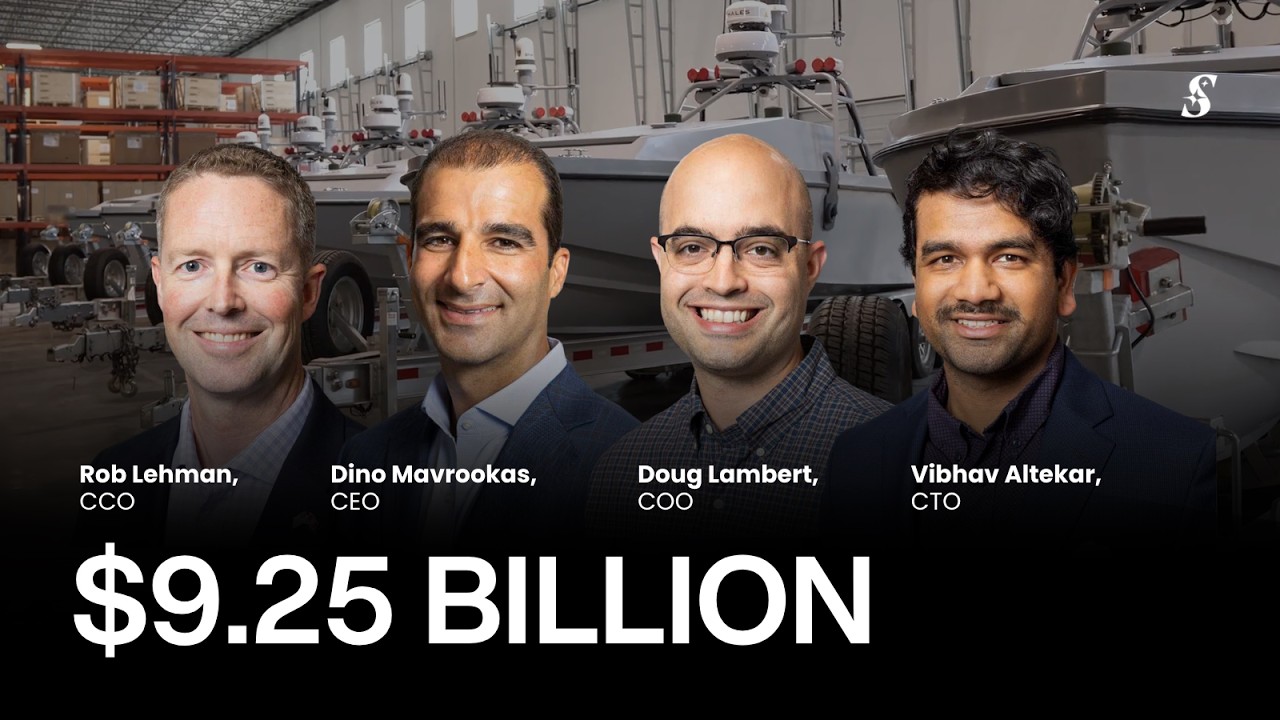
Saronic's 4 Co-Founders on Building a $9.25B Shipbuilder | Part III
Saronic's co-founders Doug Lambert, Rob Lehman, and Vibhav Altekar join Molly O'Shea to argue autonomous mass production, not exquisite manned ships, decides naval power as China outbuilds the U.S. 230 to 1—1,000+ commercial ships in 2024 to America's 5. COO Doug Lambert details the $3B Port Alpha shipyard, aluminum welding with Path Robotics, Palantir Foundry for manufacturing, and why casting, forging, and wire harnessing must return to the U.S. Rob Lehman says only 1% of the Department of War's ~$1T budget goes to autonomy, wants AI tooling so contracting officers can say yes, and aims to thank two Apache pilots Saronic tech helped. CTO Vibhav Altekar explains hardware-software co-design for 20-G impacts, redundant comms against jamming, the Nvidia partnership, and open-source AI.Sep 10, 2026 · 59:52 · 16K views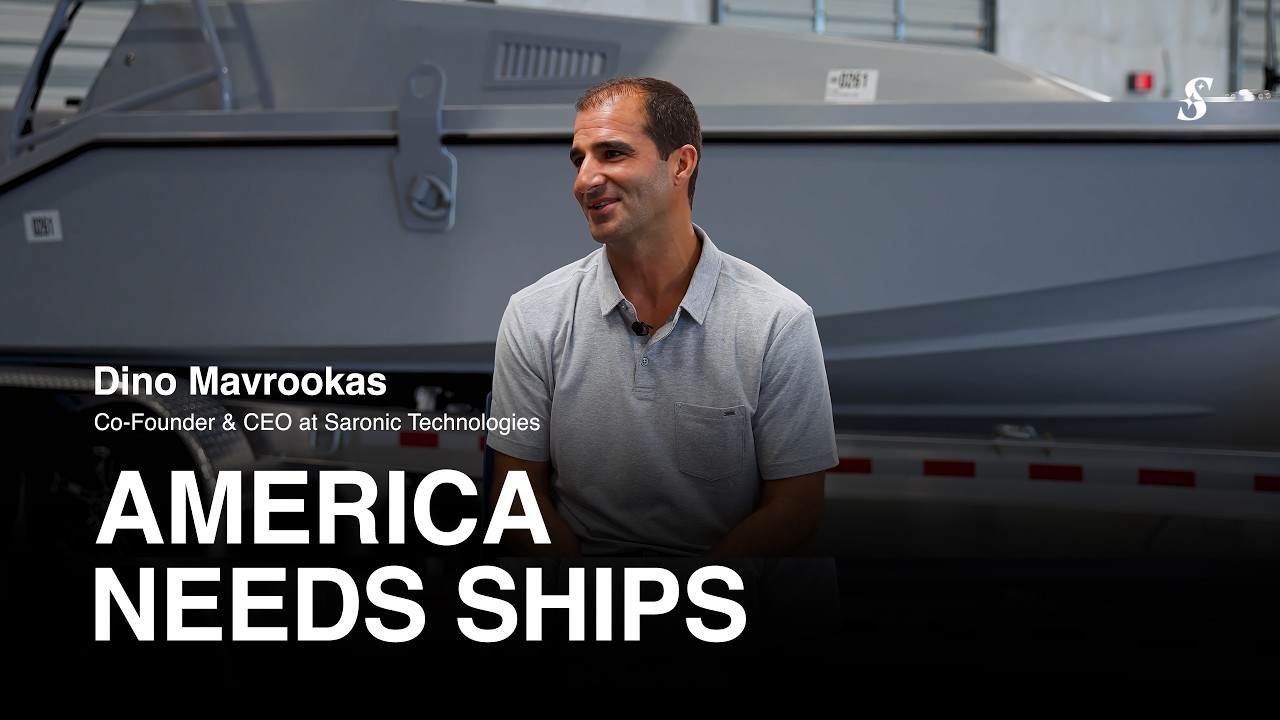
Dino Mavrookas: America Needs to Build Ships Again
Dino Mavrookas, Co-Founder & CEO of Saronic, argues America's shipbuilding gap—China outbuilds the U.S. 230 to 1, having built over 1,000 commercial ships last year against 5—is a national security crisis only autonomy and private capital can fix. He notes the Navy's 290 ships fall short of Congress's 355 minimum and the revised 381-ship need, and explains how Saronic's Corsair, Marauder and $3 billion Port Alpha shipyard—10,000 jobs and $160 billion of impact in Brownsville—answer that. He predicts 5 to 10 new defense primes in a decade and describes a Castellan partnership to launch a hypersonic missile off an autonomous ship before the Navy can from a manned one. He also recounts founding Saronic in 2022 after leaving private equity, his wife naming it after the Battle of Salamis.Sep 8, 2026 · 29:56 · 21K views
Inside Saronic’s $9.25B Autonomous Boat Factory | CEO Dino Mavrookas
Saronic co-founder and CEO Dino Mavrookas tours Molly O'Shea through the company's 420,000 sqft autonomous boat factory in Austin, Texas, arguing vertical integration of hardware and software took the 2022 startup to a $9.25B valuation. He shows the Corsair line, which can build 2,000 boats per year, and credits its linear flow with exposing bottlenecks. He boards Mirage, a 52-foot vessel with 2,500 nautical miles of range and 3,500 lbs of payload, and points to Marauder, a 180-foot ship. Port Alpha, the Brownsville shipyard on 800 acres, will add 150,000 gross tons — 1.5X U.S. capacity — and 10,000 jobs vs. China's 230-to-1 lead. He traces the $800 Amazon-raft origins, the $392 million Navy contract, and Corsair combat use in the Strait of Hormuz, including an autonomous rescue.Sep 7, 2026 · 33:01 · 245K views
Bridgit Mendler Gives Us the First Tour of Northwood's New HQ + Factory
Bridgit Mendler, co-founder and CEO of Northwood Space, gives Molly O'Shea a tour of the new 185,000 sqft Torrance factory and argues the neglected ground segment is the space economy's biggest bottleneck. Northwood has raised over $136M since 2022, including a $100M Series B led by Washington Harbour and Andreessen Horowitz, and holds a $49.8M Space Force contract for the Satellite Control Network. The factory will 5x capacity, add 400 jobs, and support hundreds of antennas a year; she explains why ground tech hasn't changed since the 1990s and how Northwood brings Portal/Prism production, machining, PCB assembly, and anechoic testing in-house. She also covers site licensing, colocation, supply-chain choices, national-security concerns, and mission ops moving into the former movie theater.Aug 31, 2026 · 46:17 · 63K views
Inside Rocket Lab: How Sir Peter Beck Is Building Neutron’s Engines | Tour 02
Sir Peter Beck, founder and CEO of Rocket Lab, gives a tour of its Engine Development Center, where 3D printing makes most of his engines, including the reusable Archimedes for Neutron. He explains why methane was chosen for quick turnaround, how the $100 million Virgin Orbit facility was bought for $16 million, and how a production line can make an Archimedes every eight days. Such engines must survive 40 starts and one hour of burns, while Electron's Rutherford has flown 93 times—the second most launched rocket behind Falcon 9—with over 930 engines sent to space. Beck also emphasizes vertical integration and shares his hot take that 'the biggest thing to be done in space hasn't even been thought about.'Aug 28, 2026 · 28:03 · 207K views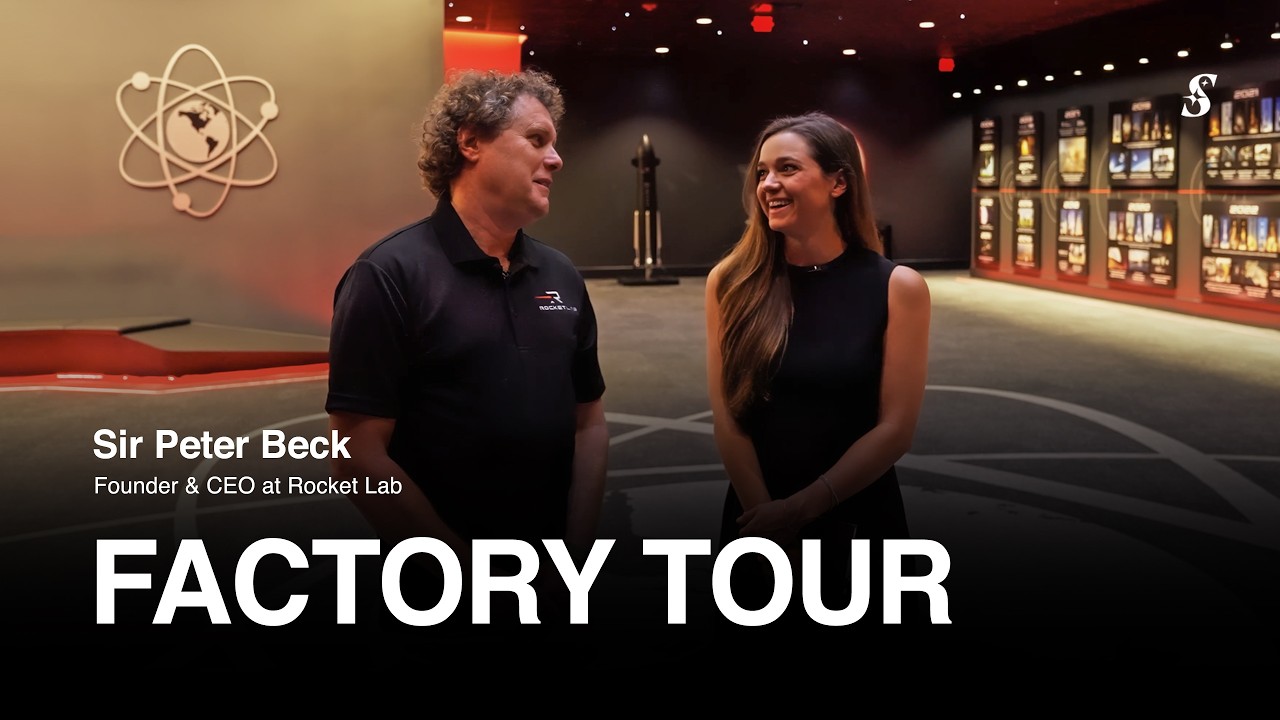
RKLB Factory Tour: Satellites, Spacecraft & Mission Control
Sir Peter Beck gives a Rocket Lab factory tour and details how the company grew from under $100,000 New Zealand dollars in startup capital into a vertically integrated space company, arguing spacecraft components are as much a moat as launch. He traces the Electron rocket reaching orbit on under $100 million and 80 people, the 2021 public listing, and three acquisitions made to impose discipline and build a multi-generational company. Beck recounts operating NASA's CAPSTONE lunar mission, his Venus life-detection dream mission, and NASA's LOxSAT liquid-oxygen storage work. He warns most new space entrants underestimate the gap between putting a satellite on orbit and building one that lasts 12 years in harsh radiation.Aug 26, 2026 · 24:50 · 112K views
How Rocket Lab CEO Sir Peter Beck Is Building a Multi-Generational Space Company
Rocket Lab CEO Sir Peter Beck tells Molly O'Shea how the company is scaling from a launch provider into an end-to-end space company, after a record Q2 2026 with $234M revenue (+62% YoY) and $2.36B backlog (+137%). Beck describes the acquisition playbook behind Iridium and component makers, arguing the moat is vertically integrated satellite components. On Neutron, he defends delays by saying investors should ask about the 10th launch, not the first, and explains the 24-hour turnaround constraint that produced the 'hungry hippo' fairing. He covers Flatellite as the platform for future constellations, Ghost as a mobile launch site for defense, and the $800M SDA contract that grew past $1B because primes needed Rocket Lab's parts. Beck also discusses going public, building a multi-generational company, and his simple operating principle: 'Just do logical things.'Aug 24, 2026 · 38:39 · 91K views
Nikesh Arora: $300B, 40 Acquisitions, Still Paranoid
Nikesh Arora, chairman and CEO of Palo Alto Networks, argues the AI cybersecurity boom is only beginning, with AI attacks compressing vulnerability-to-exploit time from 55 days to minutes. He details Palo Alto’s new 4-hour patch capability, explains why he signed Jensen Huang’s open-source AI letter, predicts the entire software industry will be rewritten in 10 years, and breaks down the playbook behind 40+ acquisitions in eight years, including the $28 billion CyberArk deal. He also describes hiring AI-native talent through hackathons, defends LinkedIn as a scouting tool, and shares lessons from Larry Page at Google and Masayoshi Son at SoftBank—including doubling down on winners. He expects market gyrations ahead but insists AI demand, and security’s role, is unstoppable.Aug 17, 2026 · 59:10 · 40K views
Inside AppLovin’s $100B Ad Engine
AppLovin CEO Adam Foroughi and CTO Giovanni Ge explain how AppLovin rebuilt its ad engine with Axon 2 after a 92% post-IPO stock drop, driving recovery from $5.5B to a $100B+ company. Ge details replacing tree-based models with neural embeddings so predictions became more accurate and GPU-cheaper, and says Axon 2's success came from deciding what not to build. Foroughi describes keeping engineering at ~100 people, using AI to elevate rather than replace engineers, expanding from mobile gaming into e-commerce via a napkin-designed data pipeline, and moving ads into connected TV and open web. They discuss why AI-generated ads need human guardrails, why taste matters more than building speed, and the path to a trillion-dollar valuation requiring $30B+ annual cash flow, plus buybacks during the downturn.Aug 14, 2026 · 1:26:38 · 69K viewsVercel CEO Guillermo Rauch argues AI agents, not humans, are becoming the internet's primary users — and Vercel the infrastructure they choose. Coding agents went from 3% to 60% of Vercel deployments in a year, and the $9.3B-valued company reports $600M annualized revenue and 485,000 paying teams. He says engineers now manage agents like engineering managers, enterprises will generate personalized software instead of buying SaaS while Salesforce survives as data infrastructure, and websites must retool for agents via MCP. Vercel's AI Gateway shows 80% of tokens flow to open models — frontier labs, he argues, face fleeting loyalty and crypto-like froth. He details a $1M sandbox bounty that surfaced a critical Linux vulnerability and predicts fluid compute as serverless's next chapter.
Guillermo Rauch, Founder and CEO of Vercel, joins Sourcery from the company's San Francisco headquarters to discuss how AI agents are transforming software development, infrastructure, and the economics of SaaS. Vercel has reportedly reached $600M in annualized revenue, growing 148% YoY, with more than 485,000 paying teams and a $9.3B valuation. Its infrastructure powers applications for OpenAI, Meta, Stripe, Shopify, DoorDash, and more. AI agents now account for 60% of Vercel deployments, up from just 3% at the beginning of 2026. Guillermo explains why coding is becoming dramatically cheaper, why companies may eventually generate software instead of buying it, and how the internet is shifting from human interfaces to agent-native infrastructure. We cover open vs. closed AI models, autonomous agents, cybersecurity, the future of SaaS, exploding compute demand, and how the role of software engineers is changing. Guillermo Rauch: https://x.com/rauchg Molly O’Shea: https://x.com/MollySOShea Sourcery: https://x.com/sourceryy 𝐄𝐏𝐈𝐒𝐎𝐃𝐄 𝐋𝐈𝐍𝐊𝐒 Apple Podcasts: https://podcasts.apple.com/us/podcast/vercel-ceo-guillermo-rauch-on-building-the-internet/id1738124704?i=1000796643017 Spotify: https://open.spotify.com/episode/1nRknCpgO5lBRiUU9yBlNA?si=HwKh9-9uSKyuFBZIiauwYQ 𝐒𝐏𝐎𝐍𝐒𝐎𝐑𝐒 • Brex—The modern finance platform, combining the world’s smartest corporate card with integrated expense management, banking, bill pay, & travel. https://brex.com/sourcery • Harvey—The AI platform built for legal work, is helping the best firms and companies close deals faster. More than 200,000 lawyers, 80% of the Am Law 100, and over 20% of the Fortune 500 build with Harvey. Visit: http://harvey.ai/ • Zone—develops next-generation data center campuses, partnering with AI companies, site developers and technology leaders to bring compute online faster and at scale. Visit: https://zonefrontier.com • Mercor—The human intelligence behind frontier AI. Frontier labs and leading enterprises use Mercor to turn the knowledge of 5M+ experts into the data, evals and benchmarks that make AI better at real work. Visit: http://mercor.com/sourcery • VCX—VCX is the public ticker for private tech, allowing investors of all sizes to invest in venture capital. View The Portfolio at http://GetVCX.com • Deel—Deel is the global people platform that helps startups hire, manage, pay, and equip anyone, anywhere. Trusted by more than 35,000 fast-growing companies, Deel is the people platform that just works, so teams can scale without the chaos. Visit: https://www.deel.com/sourcery • Public–Investing platform Public just launched Generated Assets, which lets you turn any idea into an investable index with AI. With Generated Assets, you can build, backtest, refine, and invest in any thesis with AI. Gone are the days of one-size-fits-all ETFs. https://public.com/sourcery Follow Sourcery for the latest updates! https://www.sourcery.vc Disclosure: Paid Ad. Agents are an experimental AI tool. Its output may be inaccurate and is not investment advice. Public Holding’s, Inc. makes no guarantees about its accuracy or reliability—verify independently before use. Brokerage accounts and services provided by Open to the Public Investing, Inc. See additional disclosures at https://public.com/disclosures/agenticdisclosures. 𝐓𝐈𝐌𝐄𝐒𝐓𝐀𝐌𝐏𝐒 (00:00) Guillermo Rauch, Founder & CEO at Vercel (03:32) The simplest advice for going viral (07:24) How Vercel became the index of AI (11:34) The CEO who still ships code on weekends (14:34) Robots writing code for robots (17:57) The web's next users aren't human (21:15) Is ChatGPT reading your website right now? (24:21) Minority Report is becoming real software (29:16) The end of SaaS and the rise of personal software (34:07) AI agents are soldiers with no frontal lobe (45:42) AI hackers and the coming cyber war (47:55) The $1M challenge to hack Vercel's sandbox (52:10) 80% of tokens now go to open models (59:00) The biggest risk for frontier labs (1:04:00) Can AI labs survive the public markets? (1:06:28) Why AI has Silicon Valley working 7-7-7 (1:07:23) "The thing you fell in love with is gone" (1:16:56) Your vibe-coded demo won't get you hired (1:22:22) The hardest part of running a company is keeping it simple (1:27:01) Why no company can run all its AI apps 24/7