


Intro0:00
The U.S. used unmanned sea drones for the first time during a recent attack on Iran, and a company here in Austin created those drones. Saronic is a defense tech company that focuses on creating boat-like sea drones for the military.
Not just the defense market, but the entire maritime industry is centered around autonomy. That's what we're building for at Saronic. We're actually going to be able to launch a hypersonic missile off of the back of a Marauder, which is an autonomous ship, before the Navy completes their first test of a hypersonic missile off of a manned vessel.
That's crazy.
If we ever actually do get into a conflict in Taiwan Strait that leads to World War III or anything dramatic, China can outproduce the rest of the world in terms of ships. China outbuilds the U.S. 230 to 1.
The naval fleet that we have today is actually shrinking. They built over 1,000 commercial ships last year, and the United States built 5.
One last question. It's the most difficult question.
Okay.
Some people had to walk out of the room because I asked this question.
I won't walk out on you.
What is your hottest takeright now?
Dino, welcome back. This is your second trip. We recently just went into your facility, looked at all the Corsairs, and we just saw a Mirage, and now we're here in, I don't know, what do you call this space?
This is our all-hands space. This is where we bring the team together. We hold fun events. We just had our Christmas party here. I think we had over 1,000 people at our last Christmas party.
Wow.
So this is a collaborative area where folks can come together, work in a really casual space, bring the production team together with the engineering team, and just make sure that we continuously are collaborating and just sharing information across the company.
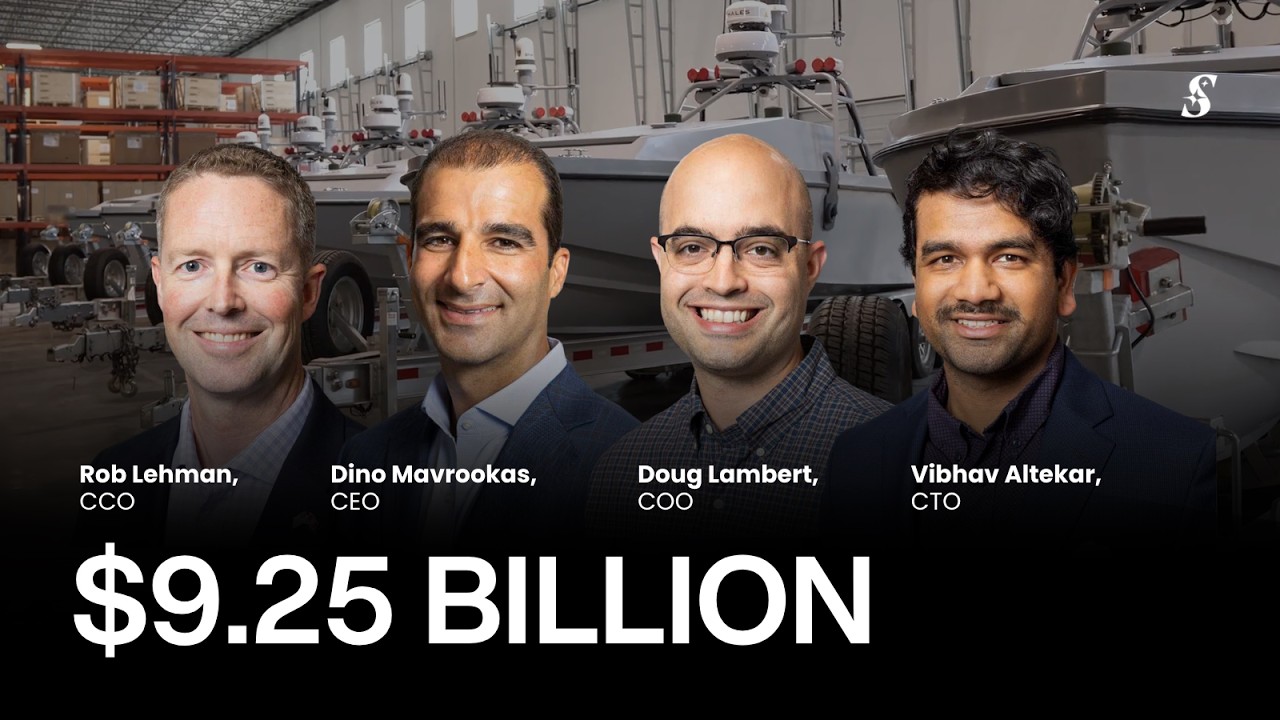
To set the table, we talked a bit about your stats when we started the last walking tour, and if you haven't watched it, you should watch it. But so you're now at over a $9 billion valuation. You raised $2.6 billion.
You've just announced, this was a little debate, is this still going to be fresh in a month? I think so. But Port Alpha, $3 billion Port Alpha.
Yeah.
So I guess to bring all that to focus against the backdrop of what's going on in America, I'd love for you to lay out kind of the stats that we're working with. Palantir CTO, Sean, just talked about this, but we're ratioed by China in shipbuilding.
Shipbuilding gap2:08
It's actually pretty crazy. So China outbuilds the U.S. 230 to 1. The naval fleet that we have today is actually shrinking. So there'sright around 290 ships in our naval fleet. In 2018, Congress actually set a statutory minimum of 355 ships.
That was eight years ago. And we're going in the wrong direction. In 2024, the Navy actually looked at it and said, "Oh, we don't actually need 355. We need 381." And these are just manned ships, let alone all the unmanned ships that we're going to need in our fleet.
And the shipbuilding infrastructure that we have in this country today just won't support that. That's why we started Saronic. That's why we started building autonomy. That's why we focus so heavily on production and manufacturing, not just of Corsair and Mirage, which we saw earlier, but of Marauder and now of Port Alpha, much larger ships.
How do we start actually building both defense and large defense and large commercial ships in this country again?
Bureaucracy3:33
I want to talk a little bit about the bureaucracy and what's kind of entangled there.
Where are we going to start?
I know. But so in that clip of Sean, he was talking about how bureaucracy has just clogged up the system, and so much so that it resulted to this. So what is kind of the state of that? I mean, we just had Rob on, and he was talking about acquisition reform.
Yeah. Well, he leads that effort for us. Front and center, every single day. He's dealing with the Navy customer. And what I will say is I'll kind of give two sides of it. One, there has been movement,right? I was in the SEAL teams for 11 years, 2004 to 2015.
My last five years were on SEAL Team 6. Again, this is the fastest I've actually seen the government move with anything. So there is a lot ofurgency around it. The new administration is putting a lot of focus in this area.
You see the president's budget request for $1.5 trillion. They put out a maritime executive order and the maritime action plan specifically around shipbuilding. You have the Ships Act, which is in Congress, which is focused on, obviously, the shipbuilding industry.
So there's a lot of focus on defense, defense technology, the industrial base, and shipbuilding. And things are changing. But when you look at the budget today, just look at the Department of War's budget. We talked about the request for $1.5 trillion and where the budget is today,right around $1 trillion for '26.
1% went towards autonomy. So that just gives you a sense of how far we actually have to go. And in terms of the bureaucracy and what needs to change, you're getting a lot of push from the top down, from leadership, from the administration, which I just highlighted, from Capitol Hill to invest in things that are not only much more economical, but also scalable.
And when you talk about ships, one of the biggest examples is aircraft carriers,right? They take over 10 years to make one. And that number increases by the day, actually, because the program is just later and later and later.
And the cost keeps going up and up and up. I was actually quoting $13 billion for an aircraft carrier. And I was at an event where the president spoke just last week, and he quoted $19 billion. And I was like, "What is happening to the budget here?"
So you have a lot of focus from Congress because, look, there's a 30-year shipbuilding plan in the Navyright now. We talked about going from 290 to 381 over 30 years. That'll cost $1.2 trillion if we can even execute as a country in the first place on that plan.
What we're building at Saronic will not only provide more capabilities faster, but it'll save the taxpayer hundreds of billions of dollars by driving down costs as well.
Scaling up6:43
You talked a little bit about this on our walk, but how do you create the path to that scale?
You do it incrementally,right? And so we've demonstrated success at each step, and then we've went after larger and larger problems. And what we've had to do, and what we've done, is really bring together a world-class team, capital to invest in that team.
And this, again, goes back to the credit to the customer where if the customer didn't move alongside us with these early wins, we wouldn't have been able to have those,right? We talked about Corsair and the large contract that we announced in December of '25, multi-hundred million dollar contract with the Navy.
If the customer didn't prioritize that, if they didn't say, "We're going to move to rapid acquisition. We're going to launch this solicitation through DIU because we need this capability, and we're just going to move fast," we would have been able to build it, but we wouldn't have been able to build the track record of success, raise more capital, invest in the next thing, which let us go and build Marauder,right?
And everything we're building here, as we could, we're investing private capital ahead of demand, ahead of need, building to scale to make sure that our warfighters get the best capability in their hands as fast as possible. And that's, you mentioned Rob talked about defense acquisition reform.
That's exactly what the Secretary of War is calling for, calling for companies to invest their own capital in really big ways, build for speed and scale. That's what the department needs. That's his words, not mine. And that's what we're building for here at Saronic.
Why do you think it's so prescient for the private sector to be doing this?
It's an all-of-country effort,right? In order to break through the bureaucracy that you mentioned, you need companies to just go and do it. You need companies like Saronic, and then Anduril was before us, and before that, you had Palantir and SpaceX to just go and build things, to show the government that there's a different way, there's a better way.
Let's not focus on cost-plus contracting and large exquisite systems and everything else. And look, before we started building Saronic, it was just a focus on big, large Navy ships. And I'm not saying that we don't need cruisers and destroyers and aircraft carriers, and there certainly is a role for the traditional fleet, and there should be investment into the legacy defense industrial base as it stands because we need the primes that exist today.
We just need other companies to be built alongside of them to support in the platforms that they're not able to build and the technology that they're not able to build to really benefit and make sure that the U.S.
remains the most powerful military in the world.
Drew Odey actually gave a couple of great questions, and one of them was, how many new primes do you think there will be?
New primes9:39
I don't know the answer to that,right?
No?
No. I mean, you don't know. There's probably not going to be 100,right? When you look back, even if you go back to 1993, I think the number is 55 or 60 or somewhere in there. And that 55 or 60 went down to 5,right, over the course of 20 or 30 years as the department kind of shrunk its budget and forced consolidation.
And now we're in the reversal of that trend. Do I think we get all the way up to 55? I mean, it just depends on your definition of prime. Prime just means a company that is contracting directly with the government, not through another company as a subcontractor.
And so, I mean, I'll define prime as contracting directly with the government at some sort of large scale. I think over the next 5 to 10 years, I'll answer. I won't dodge the question completely. I think there will be somewhere around 5 to 10.
I think you'll see 5 to 10 really big, impactful companies scale over the next 5 to 10 years, and hopefully more.
And how are you thinking about dual use in your commercial strategy?
Commercial dual use10:51
So this is something that I actually think gets overlooked a little bit, is the importance of commercial when providing capabilities to the Department of War, especially in shipbuilding. The commercial shipbuilding builds the supply chain. It builds the industrial base.
It lets you build for scale so that you're not only reliant on naval orders, which are bespoke orders and low volume. That's the first step into how this shipbuilding fiasco even started was the commercial shipbuilding industry kind of went away, and the supply chain and the workforce went with it.
If you're going to take advantage of economies of scale, if you're going to build robust and resilient supply chains, you need a commercial strategy with even Corsair's dual use,right? Very commercial focused. We're looking at everything from port and harbor security to operations with the Coast Guard and things outside of the traditional military sense.
And then as you get into larger vessels, Marauder starts actually enabling some sort of commercial logistics operations. And with Port Alpha, we're going to be looking at how do we bring autonomy into the commercial shipping industry at large for container ships and tankers and roll-on, roll-off vessels.
This lets you build a commercial revenue base, but also is actually absolutely critical for national security. Because if we don't have tankers, if we don't have roll-on, roll-off vessels, it means we actually don't have the ships to resupply our force if we're actually in a conflict or a war.
And if you go back to World War II, some of the most important ships we built were just logistics ships. So commercial is critical on so many different vectors.
Sponsors12:36
This episode is brought to you by Brex. My favorite. You become what you spend on. And I refuse to spend my time on work that shouldn't exist. Expense reports, receipt chasing, and manual closes. The companies building what's next from Vercel, OpenAI, Anthropic, Granola, and Deepgram all made the same call.
They all run on Brex. Brex is the intelligent finance platform that combines cards, expenses, and banking into a single stack with agentic finance built in. AI agents that handle expenses automatically, enforce policy before spend happens, and close your books in minutes.
That's why Sourcery runs on Brex, so I can spend time on building and not busy work. It's time to get Brex AF. Learn more at brex.com/sourcery. That's B-R-E-X.com/S-O-U-R-C-E-R-Y. Bye. Turing is training the next generation of AI with tasks that require real expertise and real-world judgment.
That's why companies like NVIDIA, Anthropic, Salesforce, and Gemini partner with Turing. Turing builds realistic reinforcement learning environments and data systems based on real operational traces, the kind of infrastructure frontier labs need to train superintelligence. Visit https://turing.com/sourcery. AI needs more than chips.
It needs power, land, and infrastructure. Zone develops next-generation data center campuses, partnering with AI companies, site developers, and technology leaders to bring compute online faster and at scale. Zone is building the foundation of the AI frontier. Visit https://zonefrontier.com/to/learnmore.
That's https://zonefrontier.com/to/learnmore.
Allies & China14:28
So for you, thinking about scale, why focus on one theater of war, and if and when do you expand?
I'll give you a fun side. I'll laugh at myself a little bit. I don't actually know this. The Army actually has more boats than the Navy does. But we're focused on all the services: Navy, Army, Marine Corps, Coast Guard.
How can we support the Air Force in combat search and rescue and other things? So we're focused on the military at large. The Navy was our initial and still is our largest customer. And as we're building autonomous surface vessels, that makes a ton of sense.
How do we redefine what that naval fleet of the future can look like and should look like? And we're figuring that out together in partnership with the Navy, but very focused on all the services, very focused on commercial, and also internationally,right?
Our allies are just as important in this effort,right? How do we make sure that our allies have the best technology out there? Because it's not just the U.S. that's struggling in shipbuilding. China has 57% of total global shipbuilding capacity.
A lot of our allies are struggling with the same things that the United States is in the lack of ability to just build ships. And if you go back in history and you look at even just back to World War II, what has typically just determined naval power is who can build the most ships.
It's not who can build the most exquisite, the most expensive, whose ships have the most on them in terms of payloads and weapons and all the other things. It's like who can just build the most? Who has the industrial base to just build the most?
And that kind of determines naval power. And that's the whole genesis behind Saronic.
Isn't there a certain like, in China, don't you have to build every boat to military grade?
I don't know. It's a very opaque market, by the way.
I would imagine.
It's very hard to get information out of there, but they're building, I'll tell you, they're building all types of ships. And the biggest discrepancy really is in the commercial market. And what that commercial market, again, lets them do is take the industrial capacity really from the world,right?
And they're doing that by undercutting on price. Their entire shipbuilding industry is completely subsidized. Not only direct construction subsidies, but they subsidize the raw materials, they subsidize the labor, and they basically give them free financing for these shipyards.
So I'll give you a commercial stat. So we're talking about 230 to 1. It's actually not as egregious when you look at just military ships. We being the U.S. launch about 5 to 10 military ships, meaning destroyer, cruiser, aircraft carrier, like straight naval vessel, warship.
China's probably doing about 30. So 6 to 1, 7 to 1, somewhere in there. They built over 1,000 commercial ships last year. The United States built 5. I think this was 2024. 5. Like 1, 2, 3, 4, 5 large ocean-going commercial vessels.
So what China's doing is they're taking the capacity from the rest of the world. Our allies, South Korea and Japan, the next two largest shipbuilders in the world, they're actually on the commercial side. They're actually getting a lot of their modules from China.
They're getting a lot of their labor from China. So as that capacity diminishes, if we ever actually do get into a, God forbid, a conflict in the Taiwan Strait that leads to World War III or anything dramatic like that, I mean, China can outproduce the rest of the world in terms of ships.
And they just keep taking that capacity by undercutting the world on price in the commercial market.
Castellan partnership18:15
So we talked about your commercial partnerships with Rob, Doug, and Vib a little bit. So between Palantir, Path Robotics, NVIDIA, are we allowed to talk about Castellan?
Castellan, yeah. Let's talk about it. So this is super exciting. Me and Brian are super tight in on this. We're basically taking they're building containerized hypersonic missiles, and we're going to do a test launch of a hypersonic missile off of the back of a Marauder.
And what we did that was so informative, like this new era of defense tech is basically Brian and I, Brian's the CEO of Castellan, by the way. Brian and I just got on the phone. We're like, "Hey, we got to go do this."
And we just got our teams together and started working on it. We're investing our own capital. We're like, "Okay, yeah, how do we make this happen?" We brought the government in. So we're eight steps ahead by the time the government even came in on this project.
And we're actually going to be able to launch a hypersonic missile off of the back of Marauder, which is an autonomous ship, before the Navy completes their first test of a hypersonic missile off of a manned vessel.
That's crazy. Are you seeing a lot of those private partnerships happen just faster because you're just able to call up your friend?
I wouldn't say it's calling up your friend, but it's calling like like-minded companies that are forming in this space that are passionate about defense, that understand it really is. I don't just say it. It really is like an all-of-country effort.
If you're going to break through the bureaucracy, you have to prove it. You have to make it demonstrable. It can't just be like, "Oh, this might be a little bit better," or even in a commercial market sense, like 10X better.
It has to be, "Look, you can't actually live without this, and here it is." And so that's what you're having companies doing. They're investing that capital. And it's backed by a lot of really great venture capitalists that are passionate about the country.
We talked about APC and Joe Lanzo, and I know Drew sent in a bunch of questions.
They actually backed us in the very beginning. We started with APC. And it was because of a conversation I had with Joe about why he's so passionate about defense. And then you look at Cafenada Capital and Andreessen Horowitz and Alag Gill and then lately Kleiner Perkins led our last round.
Those were all our lead investors. Every single one of them is passionate about the country. Yes, they're looking for a return. They want to make good investments. They want to bet on good companies. They want to bet on great people.
But at the end of the day, they're also extreme patriots. And they want to see the things that this country needs actually get built. And they're willing to take the risk and put their capital behind it.
Founding story20:58
So starting and founding the company in 2022 out of APC's build program, what was that process like for you?
Well, for me, it actually just started with, I guess, a little risk of my own. I was working at a private equity company, Vista Equity Partners, phenomenal company, and got out of the military in 2015. And being completely honest, when I left the SEAL teams, I had no idea what I was going to do next.
I was interested in finance, wanted to get into private equity, and went and did that for five years. After five years, I started to look around and say, "Is this what I want to do for the next 20 or 30 years of my life?"
I learned a ton about investing. I learned a ton about operating companies. But is this what I wanted my career to be? And the answer was no. And that really just drove me back into, "Okay, well, what do I care?
What do my path? What if I only get out of bed every single day and go and focus my energy and attention on?" And that was defense. So I walked into the living room one night and I told my wife that I had to quit my job.
And she asked me what I was going to do. And I said, "Start a defense tech company." And her follow-on question was great. "Tell me what your company does." And that's where it all fell apart. I didn't have the answers.
I just knew that I had to go and focus my energy there. And I wasn't going to come up with Saronic or at that point, whatever the idea was, if I was working 80 to 100 hours a week at a finance firm.
And so I left that job and had known Joe. And when I had the conversation with him, my very first conversation, I was like, "Please don't ask me any questions. I don't know the answers yet." And he goes, "No, I want to invest in you.
I want to help you start this company. Come build out the thesis. We'll work on this together. Once it's ready to go, we have the playbook, everything from legal, accounting, design, whatever you need to get this company off the ground fast and in a really big way."
And so they really helped us in the early days with that speed, the speed of execution, so we could just focus on building the business.
Enduring global leadership demands advanced mission systems and technologies. At Applied Aerospace & Defense, they unleash the power of precision manufacturing with unmatched scale and agility. Their customers can focus on innovation, knowing their production is backed by an undeniable heritage.
Applied Aerospace & Defense, engineered for the edge, trusted to deliver. Visit https://applied-ad.com. Today's episode is sponsored by VCX by Fundrise, the public ticker for private tech, allowing investors of all sizes to invest in venture capital. Learn more at getvcx.com.
Some of you may not have heard this yet, but our sponsor Public just launched something called Generated Assets, and it brings AI into investing in a way I've honestly never seen before. Here's how it works. You type in an idea like AI-powered supply chain companies with positive free cash flow or defense tech companies growing revenue over 25% year over year.
Public's AI then dispatches a swarm of agents that scan every single U.S. stock, evaluates them, and instantly builds a custom index around your thesis. What really stands out is how clearly it explains why each stock is included. And before you invest, you can even backtest your idea against the S&P 500, so you're making decisions with real context, not just guessing.
And beyond Generated Assets, Public lets you invest in stocks, bonds, options, crypto, all in one place. They'll even give you an uncapped 1% match when you transfer your investments over from another platform. If you want to build a portfolio that actually reflects your thesis, visit public.com/sourcery, paid for by Public Investing.
Full disclosures in the description. Founders scale faster on Deel. Set up payroll for any country in minutes, hire anyone anywhere, get visas handled fast, and get back to building. Visit deel.com/sourcery. That's D-E-E-L.com/sourcery.
Your wife helped you name the company,right?
Not just helped. She named it. Yes, 100%. We were searching for a name, and I'll never forget. I was like, "I love this story." So we're both Greek, by the way. My wife was born in Greece, and we're studying Greek history.
And we're going through a bunch of different rabbit holes trying to come up with a really cool name and a meaningful one at that, too. And I'm reading this Battle of Salamis, the story of the Battle of Salamis, and I'm just like, "Such a cool story."
You understand kind of like, "Okay, you have the Gates of Fire and the Battle of Thermopylae that leads to this big naval battle between the Greeks and the Persians in the Second Greco-Persian War. The Persians actually have much larger, much more exquisite ships.
They get lured into this narrow strait off the coast of Athens, where the Greeks have smaller, more maneuverable ships, and they're able to defeat the Persian navy and save democracy for the world, essentially." And I'm like, "Man, what an amazing story."
But you just, you can't name the company Salamis. And she looks at me, and she's reading the story with me, and she goes, "Well, why don't you call it Saronic?" And I'm like, "No, I don't like it."
You don't like it?
No, yeah. And she just, she kept at it for like three days. And finally, I was like, "Yeah, you know what? It sounds pretty cool." And the story behind it and everything, it couldn't have been a better name for the company.
It's a great name.
Yeah.
Hopefully, by the time this comes out, you see the Odyssey.
You told me I got to go see it.
There's a great lesson there on boats.
I'm going to, my kids are 11 and 10. I think I'm going to stretch them. I think I'm going to let them see it.
I think that they'll probably, it's kind of scary for the first like 40 minutes, but after that, it's okay.
Allright. Good.
Next decade26:49
Okay. So as we look forward, this is maybe a larger question, but in the next 10 years, what does shipbuilding look like if everything goesright? And if not, what do you think still will need to be fixed?
So what we're going to do at Port Alfa, you mentioned 10 years. Over the next 10 years, we're going to create 10,000 jobs. We're going to invest billions of dollars. I mean, we're going to have a $160 billion economic impact in Brownsville, Texas, and around that area where Port Alfa is based.
So what you're going to see in shipbuilding is real industrial scale come back to this country. And what you'll see in terms of defense and the commercial market is more and more things shift towards autonomy.
And that'll just enable more scale and more production because what autonomy does, it actually lets you, in addition to controlling the ship, obviously, it actually lets you simplify the design of the ship because now people aren't required. So that lets you design more simple ships.
That lets you produce at scale. That lets you drive down costs. And it lets you open up markets that traditionally weren't serviceable.
Okay, Dino. Well, one last question. It's the most difficult question.
Hot take & close27:58
Okay.
Some people had to walk out of the room because I asked this question.
I won't walk out on you.
What is your hottest takeright now?
I mean, we're sitting here talking about maritime autonomy. I'm just going to, I'll keep it plain and simple. I do believe I'm like fully convicted in the future of not just the defense market, but the entire maritime industry is centered around autonomy.
And that's what we're building for at Saronic.
Amazing. Cool. Well, thank you so much. And thank you for letting us hear for the whole day. It's really awesome seeing everybody come in and out. There's a good gender ratio as well. I respect that.
Allright. Well, yeah, we're very focused on, look, it's, we just hired the best people. We're very, very blessed to have truly, truly amazing people here at Saronic. And I tell them all the time, like, it is you all that make this company successful.
We could have all the capital in the world, the most willing customer, cool product. It's the people that make this company go. And in four years, we've grown to 1,800 people. And I focus every single day on just keeping that simple fact ingrained in the culture around how do we focus on team and mission.
If everybody comes in and says, "What is my highest and best use of time for the team?" Like, what does the team need today? And what's our, what is mission success? And I'm going to go do whatever it takes.
Then that's all we could ask. And we are like truly blessed with the people in this company.
It's incredible. Thank you.
Awesome. Thank you.
Hey, it's Molly. If you enjoy our interviews, check out our newsletter, sourcery.vc, where we deliver a once-a-week top deals and tech headlines email and also go deeper on our podcast interviews. Subscribe to Sourcery today. And don't forget to subscribe to the podcast on YouTube, Spotify, Apple, or wherever you listen.
Link in description to sign up.