
Peter Beck
GuestGuest on Sourcery with Molly O'Shea.
3 episodes

Inside Rocket Lab: How Sir Peter Beck Is Building Neutron’s Engines | Tour 02
Aug 28, 2026 · 28:03
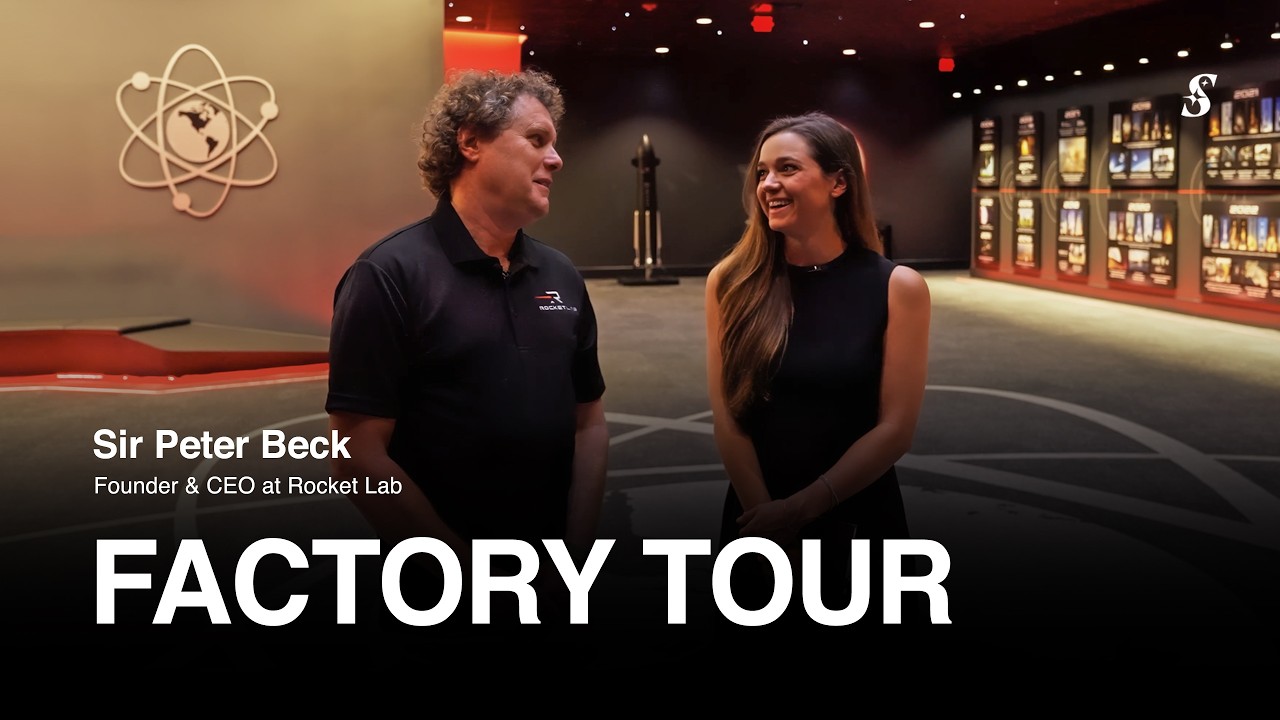
Sir Peter Beck, founder and CEO of Rocket Lab, gives a tour of its Engine Development Center, where 3D printing makes most of his engines, including the reusable Archimedes for Neutron. He explains why methane was chosen for quick turnaround, how the $100 million Virgin Orbit facility was bought for $16 million, and how a production line can make an Archimedes every eight days. Such engines must survive 40 starts and one hour of burns, while Electron's Rutherford has flown 93 times—the second most launched rocket behind Falcon 9—with over 930 engines sent to space. Beck also emphasizes vertical integration and shares his hot take that 'the biggest thing to be done in space hasn't even been thought about.'
RKLB Factory Tour: Satellites, Spacecraft & Mission Control
Aug 26, 2026 · 24:50
Sir Peter Beck gives a Rocket Lab factory tour and details how the company grew from under $100,000 New Zealand dollars in startup capital into a vertically integrated space company, arguing spacecraft components are as much a moat as launch. He traces the Electron rocket reaching orbit on under $100 million and 80 people, the 2021 public listing, and three acquisitions made to impose discipline and build a multi-generational company. Beck recounts operating NASA's CAPSTONE lunar mission, his Venus life-detection dream mission, and NASA's LOxSAT liquid-oxygen storage work. He warns most new space entrants underestimate the gap between putting a satellite on orbit and building one that lasts 12 years in harsh radiation.

How Rocket Lab CEO Sir Peter Beck Is Building a Multi-Generational Space Company
Aug 24, 2026 · 38:39
Rocket Lab CEO Sir Peter Beck tells Molly O'Shea how the company is scaling from a launch provider into an end-to-end space company, after a record Q2 2026 with $234M revenue (+62% YoY) and $2.36B backlog (+137%). Beck describes the acquisition playbook behind Iridium and component makers, arguing the moat is vertically integrated satellite components. On Neutron, he defends delays by saying investors should ask about the 10th launch, not the first, and explains the 24-hour turnaround constraint that produced the 'hungry hippo' fairing. He covers Flatellite as the platform for future constellations, Ghost as a mobile launch site for defense, and the $800M SDA contract that grew past $1B because primes needed Rocket Lab's parts. Beck also discusses going public, building a multi-generational company, and his simple operating principle: 'Just do logical things.'
Powered by PodHood